


Data and BI for Nonprofits Starts With Operational Visibility
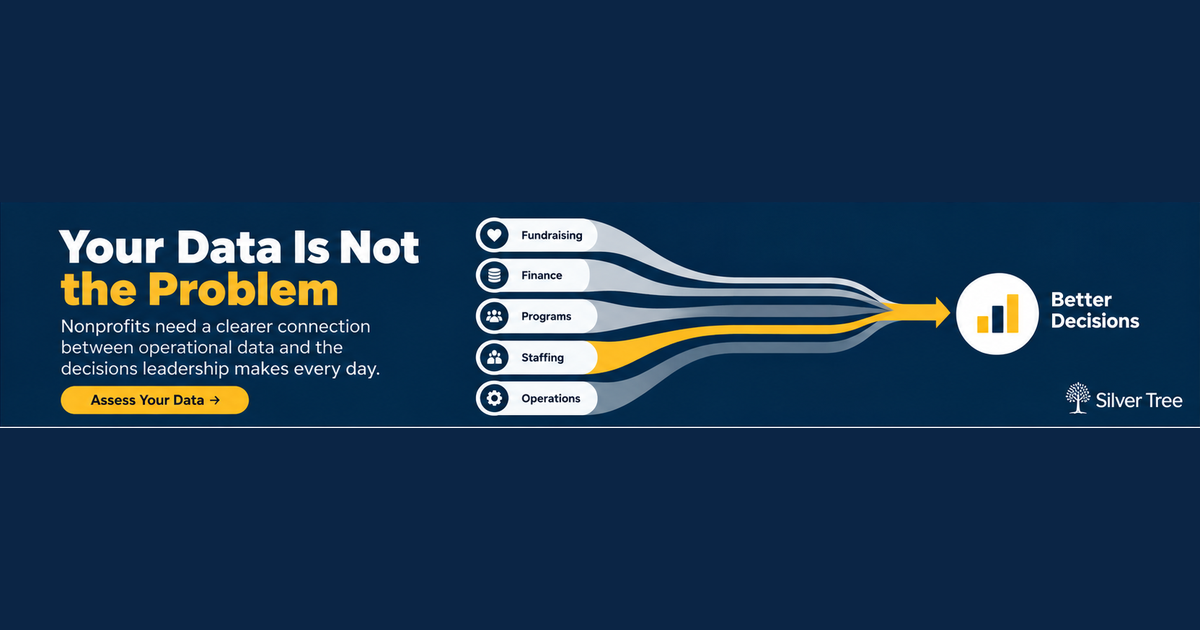
79% of nonprofits cite staff time as a primary data challenge. True BI value starts by connecting operational data directly to leadership decisions.
Key Takeaways
- Staff hours get swallowed up by basic data entry: software limitations (57%) and clunky processes (61%) leave close to 80% of nonprofits struggling just to get clean data together (NTEN, July 2025).
- Data is collected, not applied: Gathering metrics for external reporting is common, yet fewer than a quarter of leaders regularly use those metrics to guide business decisions (NTEN, July 2025).
- AI requires more than adoption: Simply adding AI to existing workflows has yielded meaningful mission results for just 7% of nonprofits, despite 92% trying the technology (Virtuous and Fundraising.AI, February 2026).
- The secret to tech ROI is behind the scenes: shiny new tools mean nothing if the underlying data is a mess. Successful organizations put up to four times more money into basic data maintenance, staff preparation, and change management (Gartner, April 2026).
TL;DR
Having loads of data means nothing if you can't rely on it in critical moments. Collecting information isn't the real struggle for nonprofits, but when software apps don't talk to each other, teams waste time on manual fixes just to get basic answers. Throwing AI into that situation doesn't solve anything. It actually exposes the flaws faster, because smart tools can't produce good work out of bad data.
The smartest starting point is simple: connect your everyday operations to the actual choices leadership has to make.
You almost never hear a nonprofit leader say they lack data.
What you hear is how exhausting it is to get one reliable answer.
A program team has information in one system. Finance has another version of the numbers. Fundraising has its own reporting process. Leadership then waits for someone to reconcile everything before a decision can be made.
NTEN's 2025 Data Empowerment Report puts numbers behind that problem. More than 79% of participating nonprofits identified individual staff time as a challenge in collecting data. 61% pointed to data entry or governance processes, while 57% identified existing tools and software as a challenge.
This goes beyond just slow reporting.
It directly limits how quickly leadership can get a real look at their programs, money, staffing, and operations.
For non-profit leaders, the stakes are getting higher now that AI tools are creeping into daily tasks. The data foundation that supports reporting is increasingly the same foundation that determines whether AI can produce useful results.
People that get real value from data aren't always tracking more of it. Instead, they link what they already have directly to the choices they need to make.
A nonprofit can sit on a mountain of data and still have zero operational visibility.
A nonprofit can have a cloud CRM, financial system, program database, spreadsheets, survey tools, and website analytics and still struggle to answer a basic leadership question.
What is really going on across the organization?
According to NTEN, 92% of nonprofits operate with a cloud CRM or database, with 89% collecting their data through direct manual entry from staff.
That pairing is key.
Running modern software doesn't mean your information is linked, reliable, or simple to navigate.
Take a nonprofit rolling out a job training program to two new sites, for instance.Program leaders may track participation and outcomes. Finance tracks spending. Development tracks restricted funding. Leadership wants to know whether the expansion is producing the expected results relative to its cost.
Each team may have the information needed to answer part of the question. The problem is getting those pieces together quickly enough to support the decision.
NTEN's research found that 49% of organizations always use data for internal reporting and evaluation. But only 22% always use data to inform regular decision-making, that difference is important because reporting tells leadership what happened. Operational intelligence helps leadership decide what to do next.
For a CEO or COO, that means the priority is not another dashboard simply because dashboards are available. The priority is creating a reliable view of the metrics that connect programs, resources, and outcomes.

Better data foundations matter even more as nonprofits adopt AI
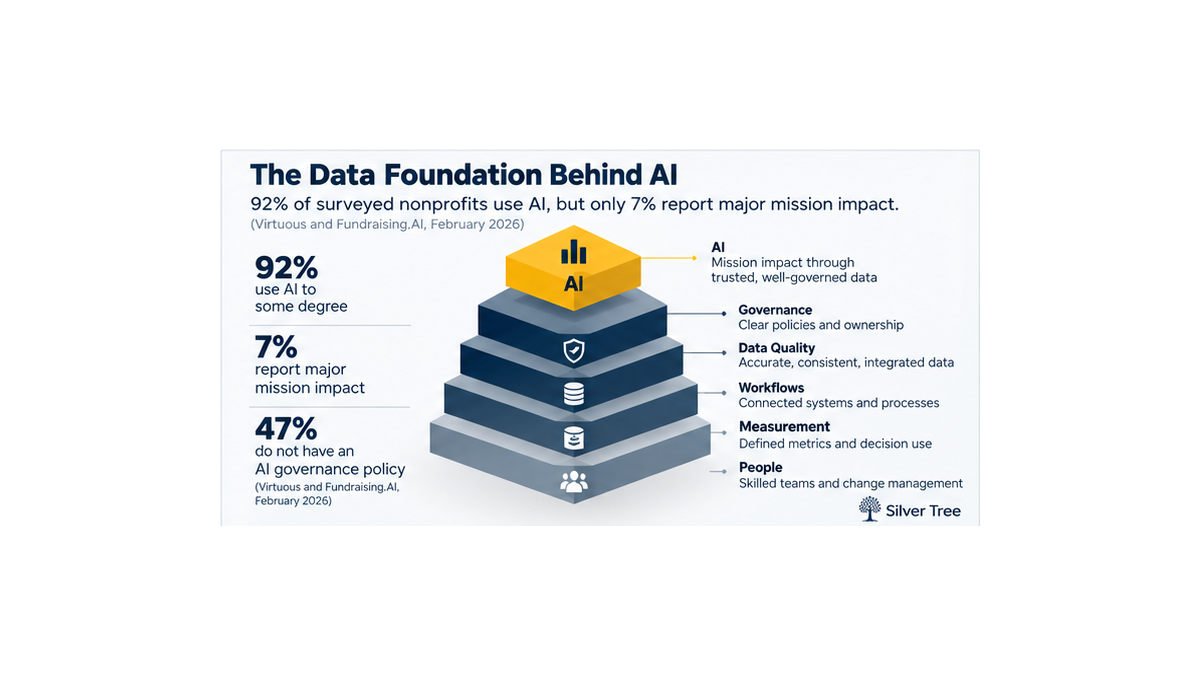
AI makes handling information much cheaper, but it doesn't change the need for reliable data. According to the 2026 Nonprofit AI Adoption Report covering 346 organizations, 92% of nonprofits use AI to some degree. Even so, just 7% saw major improvements in fulfilling their mission, and 47% haven't established an AI governance policy yet (Virtuous Software).
A fundraising team might use AI to draft donor communications. A program team might use it to summarize qualitative feedback. Finance might use it to analyze recurring reports. Those individual uses can save time.
But they do not necessarily improve the organization's ability to make decisions.
That requires AI to work from consistent information, within defined processes, with clear ownership and measurement.
Gartner's April 2026 research reinforces the point. Organizations reporting successful AI initiatives invest up to four times more, as a percentage of revenue, in foundational areas including data quality, governance, AI-ready people, and change management. Gartner also found that only 39% of technology leaders were confident their current AI investments would have a positive financial performance impact (Gartner).
Which means choosing AI use cases based on the organization's actual data readiness. If donor records are inconsistent, automating donor segmentation may amplify the problem.
If program data is trapped in separate systems, AI may produce a polished answer without giving leadership a reliable picture of performance.
AI can accelerate a process. It cannot decide whether the process itself is trustworthy.
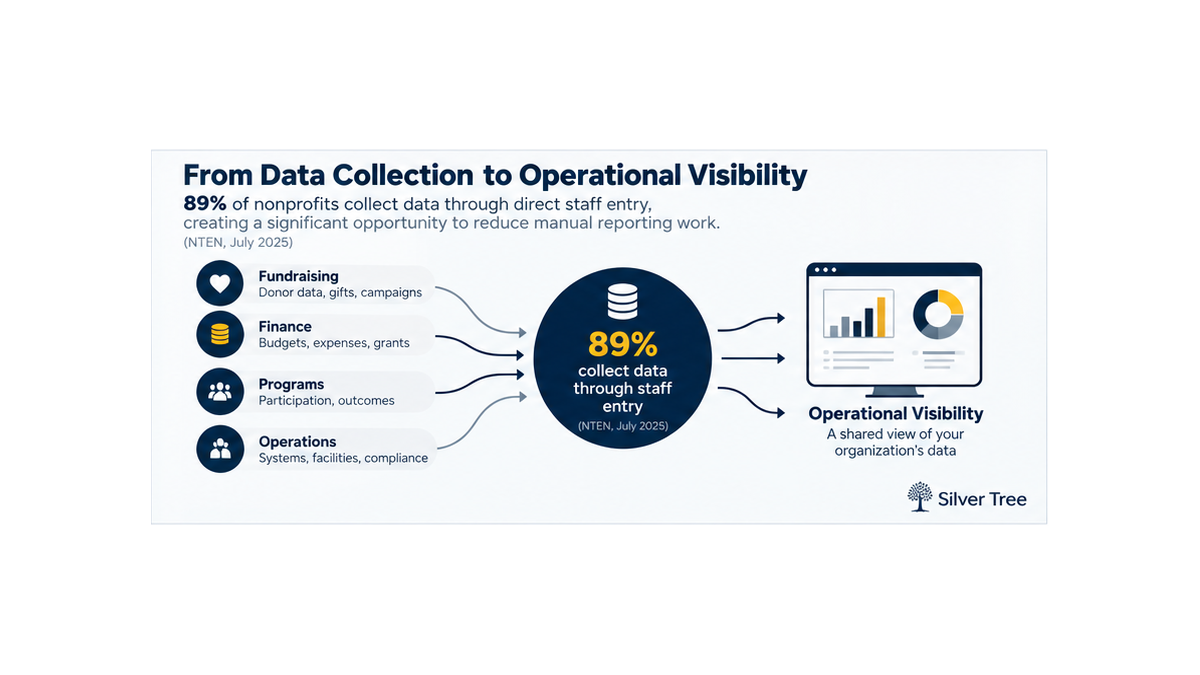
Operational intelligence connects financial resources to program outcomes
The real value of Data and BI appears when leadership can connect resources to outcomes without building a new spreadsheet every time a question comes up.
Imagine a nonprofit reviewing its quarterly performance. Revenue is on target. Program participation is up. Staffing costs have increased. A particular program appears successful based on participation, but its cost per participant has also risen.
A traditional reporting process might present these metrics separately.
An operational intelligence approach connects them.
Leadership can see the relationship between funding, staffing, program activity, and outcomes in the same decision context.
That changes the conversation from
"How did this program perform?" to "What should we change next quarter?"
NTEN's data proves just how tough this is. Nearly half of respondents mean, 49% always run evaluation numbers internally, but that habit drops off fast. Only 23% always use data to shape programs, while 22% regularly guide choices with it.
The issue is not necessarily a lack of analytical ambition. Capacity is a practical constraint. Almost 70% of respondents identified having in-house staff who can manage or implement technology as a challenge, that is where the design of the data environment matters.
The goal is to reduce the amount of manual work required to produce a trusted answer and make the important metrics visible to the people responsible for acting on them.
For leadership, this means pulling CEOs away from constant report reconciliation so they can focus on making strategic funding decisions.
A focused data readiness review can identify where reporting breaks down and which gaps should be addressed before investing in additional analytics or AI.
The next stage is moving from reporting infrastructure to decision infrastructure
Nonprofits are actively laying the groundwork for this shift. NTEN reports that 64% of organizations intend to fund staff data training over the coming 3 to 12 months. Additionally, 54% are focusing on better internal reporting, while 46% aim to implement AI. Set against each other, these goals reveal an essential question of timing and order.Adding another reporting tool does not solve a process problem.
Training staff without clarifying ownership can create more inconsistent practices. Introducing AI without governance can create new risks while making existing data problems harder to see.
The work needs to connect.
Silver Tree has more than $1.6 million in active Data and BI engagements across the NGO and nonprofit sector. In one Kellogg engagement, the focus is on building analytics infrastructure that connects operational data to decision-making at scale.
The work follows a simple progression through the Silver Catalyst methodology:
- See and Advise: establish the current data state and identify the intelligence leadership actually needs.
- Execute and Measure: build the infrastructure, connect relevant sources, and tie reporting to measurable decisions.
- Optimise and Lead: use performance information to continuously improve how the organization operates.
The point is not to create a perfect data environment before leadership can act. It is to establish enough visibility, governance, and measurement to make the next decision with greater confidence, this distinction matters because the data strategy eventually becomes an operating strategy. Once leadership depends on a metric to allocate funding, adjust staffing, expand a program, or evaluate impact, the quality of that data is no longer an IT concern.
It is a business decision.

FAQs
How can a nonprofit tell whether its data is ready for better BI?
Look at how long it takes to answer basic leadership questions and how much manual cleanup is required to get there. If teams regularly maintain separate versions of the same metric, the issue is usually broader than dashboard design. NTEN also found that fewer than a quarter of organizations always use data to inform regular decision-making, which suggests that reporting capability and decision capability are not the same thing.
Should nonprofits fix their data before adopting AI?
Not necessarily. A stronger approach is scaling AI ambitions alongside data quality and governance. Starting with low-risk tasks allows teams to build skills while underlying systems improve, but higher-impact tools depend on strong data ownership, clear rules, tracking, and smooth process integration. Gartner's research shows that successful AI initiatives place substantial investment behind those foundations (Gartner).
What should nonprofit leadership measure from a Data and BI investment?
The measures should connect to operational decisions rather than simply tracking dashboard usage. Key metrics might include reporting lead times, cross-department alignment on figures, decision speed, cost per outcome, and how often leadership relies on trusted data. The best measures always reflect an organization's distinct operational model and core goals.
What does a Silver Catalyst assessment help a nonprofit understand?
Silver Catalyst shows you where your tech stands, what’s broken, and what to fix first. Through Silver Tree’s Data Readiness Assessment, we talk with your team, evaluate your setup across Data, BI, Analytics, and AI, and build a clear, step-by-step plan to fix the gaps.
When reporting takes too much effort, the problem is bigger than reporting
Data problems rarely stay inside the data team. They show up as slower decisions, duplicated work, unclear accountability, and uncertainty about whether programs are producing the intended results.
A useful assessment should make those gaps visible before another system or AI tool is added.
First, get a realistic view of your data environment, understand what is creating friction, and map out the right path forward.

Darwin Herdman brings over 30 years of leadership experience in building, scaling, and optimizing managed service operations for a diverse range of organizations—including small and mid-sized businesses (SMBs), Fortune 100 enterprises, state and local governments, and tier-one telecommunications providers.
Throughout his career, Darwin has led high-impact initiatives that modernized IT service delivery, streamlined operations, and introduced automation frameworks at scale. His work spans every layer of the managed services stack, from service desk and infrastructure management to cloud operations, security services, and digital employee experience platforms.
Darwin's deep expertise in operational design, service orchestration, and technology transformation makes him uniquely qualified to articulate the vision and operational blueprint for Autonomous IT. His insights are grounded in decades of real-world execution, delivering measurable outcomes for some of the most complex and high-demand IT environments in North America.
