AI360 Secure
Built for midmarket teams who have to answer for what AI is doing in their business, without the headcount to staff that function themselves.
95% of enterprise AI pilots never reach production or deliver profit and loss impact, according to MIT's NANDA Initiative. Richard Ricks sees the same pattern at Silver Tree: the investment gets approved, the pilot launches, and six months later nobody can point to the revenue, cost savings, or risk reduction it was supposed to deliver. AI360 Secure closes that gap by making someone accountable for the outcome every day the AI runs, not by adding another tool to the stack.
25-40%
Reduction in manual effort across Silver Tree AI360 engagements
<25%
Of enterprise AI investments realize their intended value (Richard Ricks, Silver Tree)
95%
Of enterprise AI pilots never reach production or P&L impact (MIT NANDA Initiative)
A team stands up a copilot pilot in procurement. Another builds an internal chatbot off a weekend project. A third wires an agent into customer data and nobody outside that team knows it exists. When a board member asks what AI is running and who approved it, the honest answer is often nobody fully knows.

When a regulator, acquirer, or board member asks what AI is touching your data right now, a team without an inventory has no good answer. That question surfaces during an audit, a deal, or a breach, never on a convenient timeline.

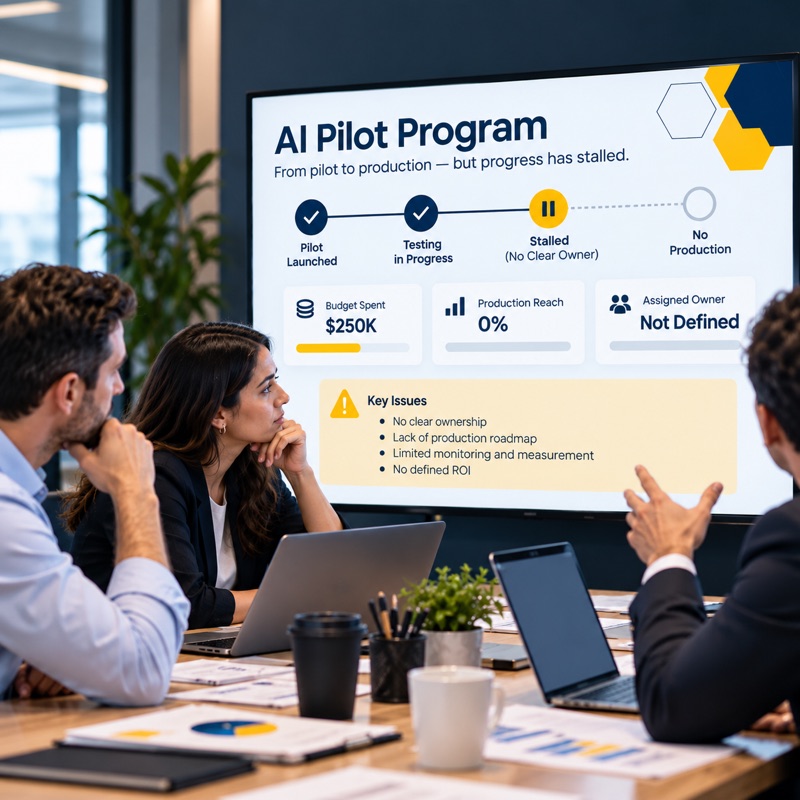
95% of enterprise AI pilots never reach production, per MIT's NANDA Initiative. Each one is budget spent and board expectations set, with nothing to show for either. The model rarely fails. The release gates, monitoring, and named owner around it do.

Each new copilot or agent is new exposure: a data leak that becomes a disclosure obligation, a cost spike nobody budgeted for, an outage with no owner to call. Every use case added without governance added is a liability the business can't yet size.
AI has to pay off and stay controlled at the same time. Treat it only as a cost center to lock down, and the business case never gets built. Treat it only as a growth lever, and the first incident undoes the investment case entirely. AI360 Secure manages both sides of that equation at once.
Value Realization
Prioritizes the highest-value use cases, redesigns the workflow around them, and tracks the KPIs that prove ROI, not just deployment.
Prioritized high-value use cases
Faster time to value
KPI and ROI measurement
Continuous optimization and scale
Silver Tree AI Engine
One AI Operating Core
Aligned Strategy, Unified Execution.
Risk Management
Governs the risks that undermine adoption: data exposure, compliance violations, inaccurate decisions, reputational harm, operational disruption.
Data exposure
Compliance Risk
Poor decisions
Reputational harm
Operational disruptions
A commercial copilot adopted last quarter needs different oversight than an agent already in production, and different again from a use case still in the pipeline. AI360 Secure runs all three without forcing everything through the same process.
Commercial AI tools, copilots, and internally built solutions
Turns "nobody fully knows" into an inventory, a risk classification, and an approval record your board can actually see.
AI already in production: copilots, agents, retrieval, and models
Catches the incident before it becomes a headline, a disclosure obligation, or a cost overrun nobody saw coming.
Teams ready to expand what AI is doing for them
Keeps the investment case honest: expands what is proving its value, retires what is not, instead of letting the backlog grow on momentum alone.
A use case that skips one of these stages is the one that ends up in the 95% that never reach production, or the one that reaches production without anyone able to explain why it is there. AI360 Secure runs every use case through all eight: Discover, Govern, Design, Build, Assure, Operate, Measure, Scale.

When a board or an auditor asks what standard your AI governance is built on, "we have a policy" is not a credible answer anymore. AI360 Secure aligns to NIST's AI Risk Management Framework (Govern, Map, Measure, Manage) and OWASP's GenAI Security Project, and maps to ISO/IEC 42001 where a client's compliance posture requires it. These are reference points, not certifications. Silver Tree states what it aligns to and does not claim what it has not earned.

A vendor starting from zero spends your first quarter on discovery, billed at your expense. Years running data strategy, analytics, DevOps, and managed cloud for the same clients means AI360 starts already knowing the environment.

Running five AI tools from five vendors should not mean five governance models to maintain. Microsoft Copilot, Azure AI, OpenAI, Anthropic, AWS, Snowflake, and ServiceNow all run under the same one.

A strategy team that leaves after the roadmap and an operations team that inherits a system it did not design is how accountability disappears. The practice that advised on the use case is the same one monitoring it in production.
A governance program that cannot produce numbers stops being an operating model and turns into paperwork. AI360 Secure reports on the same cadence as the rest of IT operations, not once a year when an auditor asks.
Percentage of AI use cases inventoried and risk‑classified
Time from use‑case intake to approval
Production AI availability and incident rate
Adoption and active‑user growth by use case
Benefits realized against the original business case
AI360 Secure runs on the same team that has already assessed and prioritized AI use cases for midmarket engineering and architecture firms. These three are drawn from that broader advisory work, anonymized at the client's request. None are AI360 Secure engagements specifically, and the page should not imply otherwise. They show how Silver Tree sizes an AI opportunity before recommending anything.
View All Case Studies

AI-powered visual search cut average drawing search time from 15 minutes to 5. Silver Tree's assessment projected a six-figure annual gain in recovered engineering capacity, plus savings from eliminated drawing rework.

Of four AI use cases assessed, an automated spec-to-drawing cross-check ranked highest priority, ahead of a BI dashboard and a knowledge-management tool, because undetected errors carried direct legal and financial exposure.

An AI tool aimed at reducing simulation iterations and expert-review dependency was projected to save 20 to 30% of time against a baseline of roughly 1,400 to 1,600 billable hours per engineer per year.


An AI Value and Risk Assessment takes two weeks and tells you what is actually running, what it is worth, and what it is exposed to.