
Why AI Investments Fail and What Governance Actually Fixes
Less than 25% of AI investments deliver measurable value across mid-market organizations. While 80% of workers report productivity gains, only 37% of companies see a positive EBIT impact. Discover how AI governance bridges raw technology spending and actual business outcomes through structured control, security, and accountable execution.
Key Takeaways
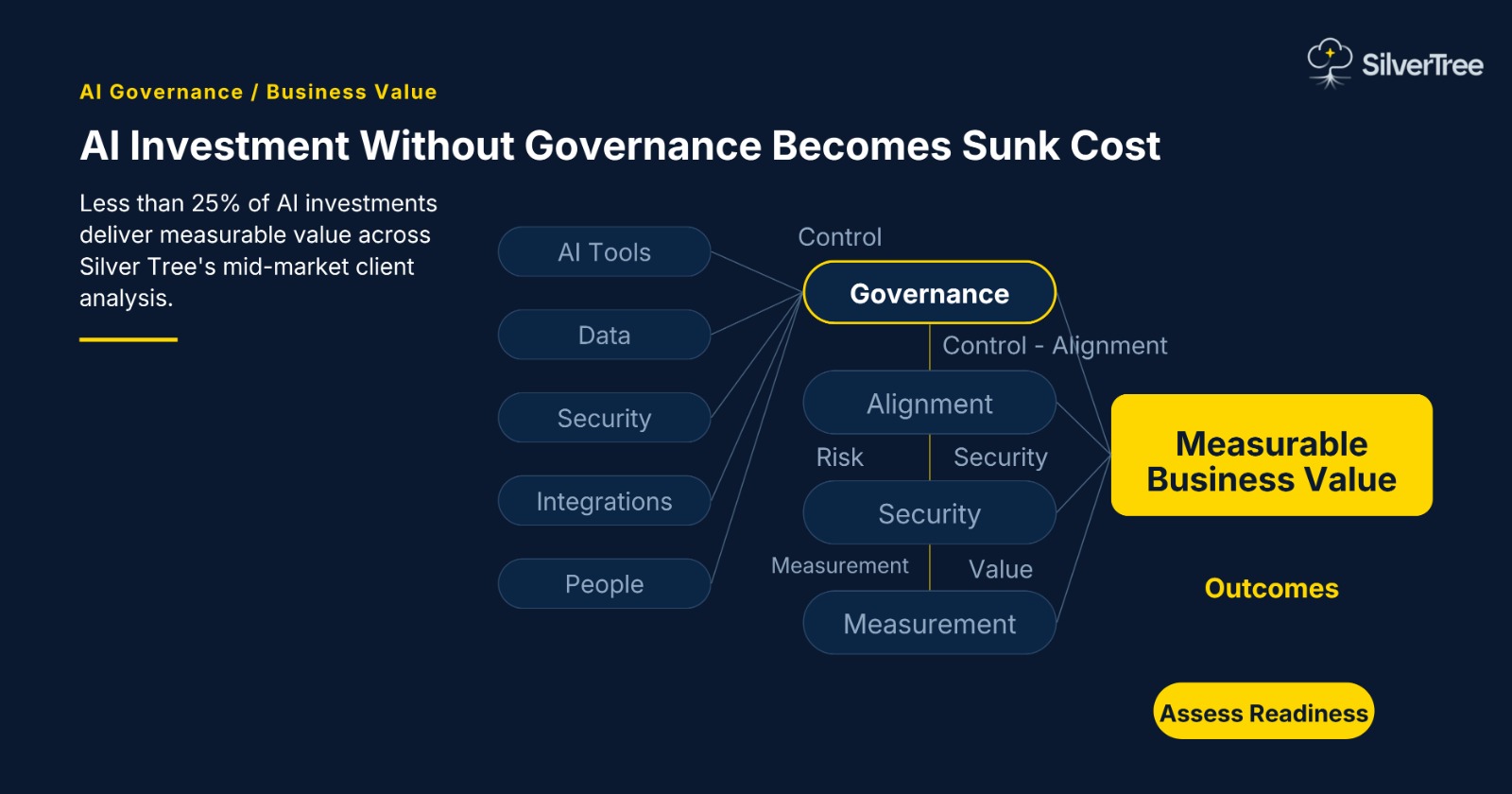
- Less than 25% of AI investments deliver measurable value in Silver Tree's market analysis across mid-market clients, making value measurement a governance issue rather than a technology issue.
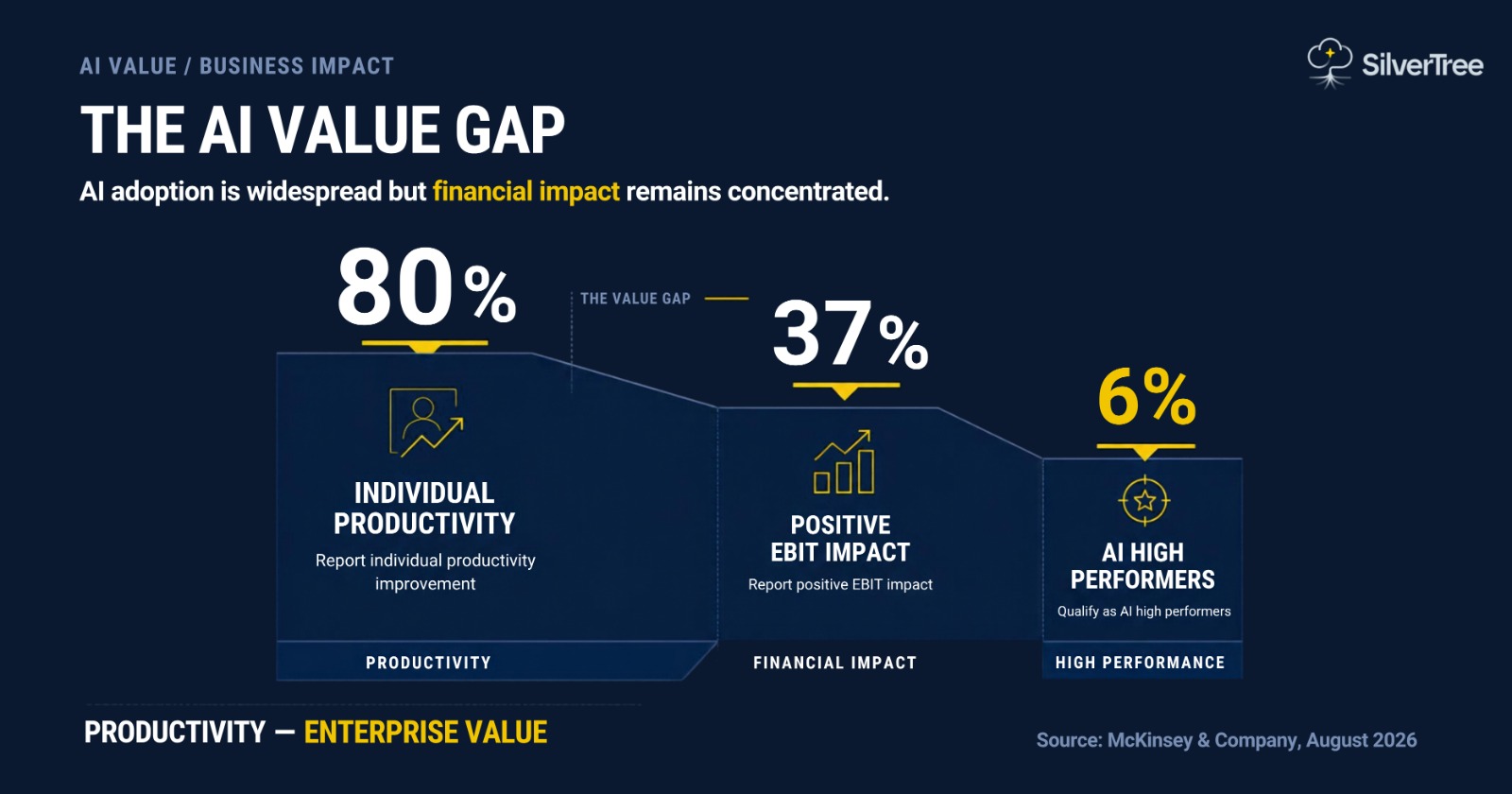
- 37% of organizations report any positive EBIT impact from AI, while only 6% qualify as AI high performers, despite widespread individual productivity gains (McKinsey, August 2026). (McKinsey & Company)
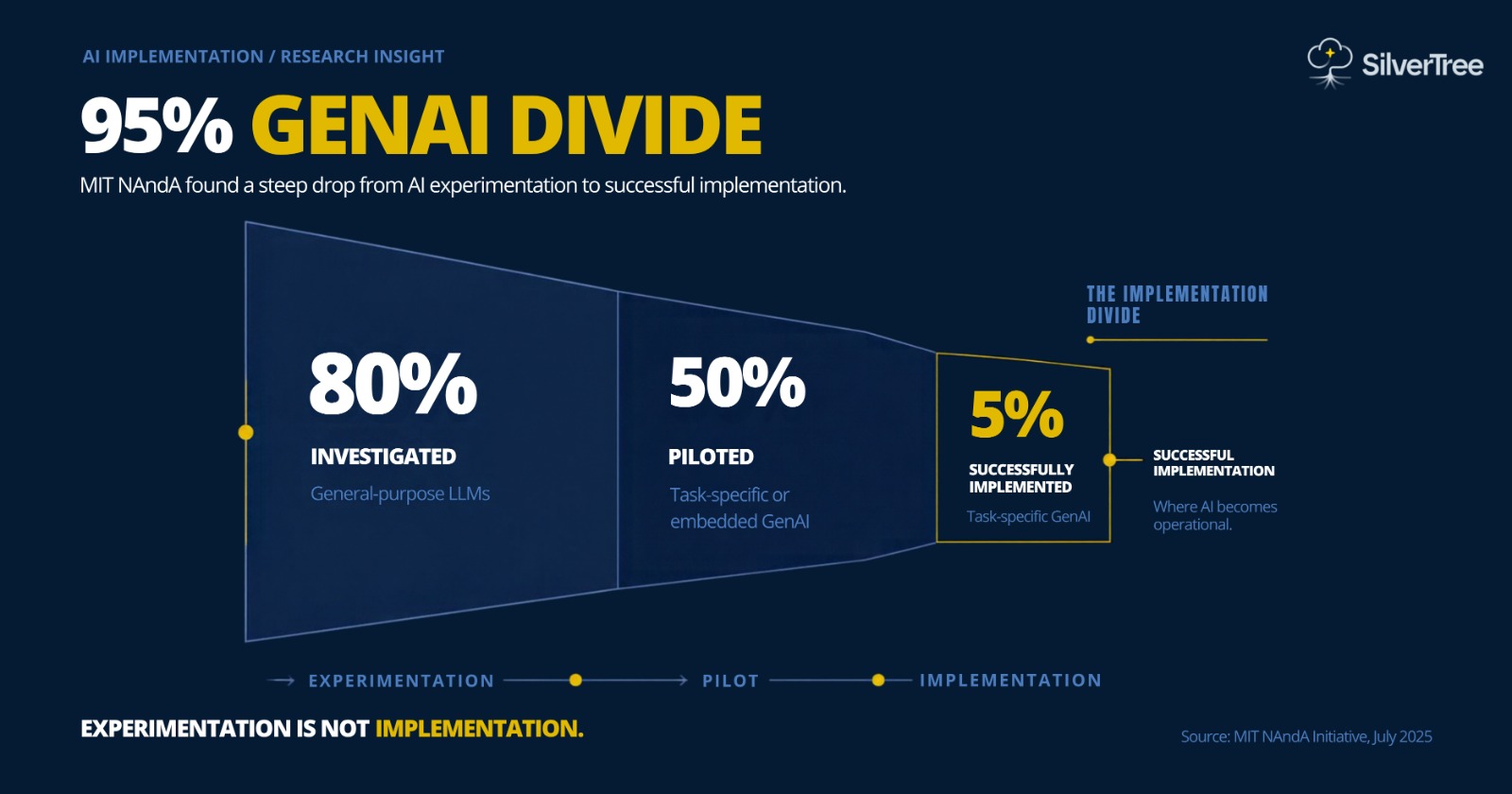
- MIT NANDA found that 95% of organizations in its research were getting zero return from GenAI investment, with just 5% of integrated AI pilots extracting significant value (MIT NANDA Initiative, July 2025).
- Mid-market companies represent roughly one-third of private-sector GDP and employment in developed economies, but their historical technology investment levels have lagged larger businesses (World Economic Forum, January 2026). (World Economic Forum)
If an AI programme is already underway, a complimentary 10-point AI readiness assessment can identify where value, governance and accountability are breaking down.
TL;DR
AI investment is increasing faster than measurable financial returns. Everyone is getting faster with AI, McKinsey’s August 2026 data shows an impressive 80% of workers report individual productivity boosts. Yet, only 37% of companies see any real bump in bottom-line profits, and a mere 6% truly excel. Why the huge disconnect? It comes down to governance. Governance isn't red tape; it’s the bridge between raw AI spending and actual business results, demanding clear use cases, accountable leaders, tight security, and reworked workflows. For mid-market CEOs, the core challenge isn't deciding if to buy into AI, but whether you have the discipline in place to prove it was worth it.
An AI investment can consume six months of leadership attention, a technology budget and several internal teams without producing a number that belongs on the CFO's dashboard. That is the failure Silver Tree's market analysis sees repeatedly: less than 25% of AI investments deliver measurable value across mid-market clients. Wider industry research highlights the exact same issue. In McKinsey’s 2026 survey, 80% of employees state AI boosts personal efficiency, but only 37% see a real EBIT lift. Furthermore, a tiny 6% qualify as AI high performers, defined as businesses driving over 5% of EBIT from AI and recognizing it as a major contributor (McKinsey, August 2026).
The gap is not explained by a lack of capable models. It is the gap between an AI tool working and an AI investment working. That gap is structural. It all comes down to the choices you make before pressing deploy: defining the actual business problem, deciding who owns the outcome, locking down data permissions, managing risk, and knowing exactly how you’ll measure success.
AI value breaks down when the investment is not connected to a business outcome
The scale of adoption makes the value gap harder to ignore. McKinsey’s numbers speak for themselves: roughly nine in ten businesses run AI in some department. At the same time, enterprise scaling hit 44%, up from 38% just twelve months prior (McKinsey, August 2026).
Yet financial impact has barely moved. The share reporting positive EBIT impact remains at 37%. About 28% of businesses sink more than 10% of IT budgets into AI right now, and 60% expect higher spend ahead. But budget realities persist. 20% of firms say sheer operating costs are holding back their AI deployment (McKinsey, August 2026).
MIT NANDA's findings bring the deployment headache into sharper focus. After digging into 300+ public AI efforts, interviewing 52 industry stakeholders, and surveying 153 leaders, they discovered 95% of firms get zero ROI from GenAI. Meanwhile, a tiny 5% with integrated pilots are pulling in millions in value. Its definition of success required deployment beyond the pilot phase with measurable KPIs (MIT NANDA Initiative, July 2025).
The failure point is often workflow fit. MIT NANDA found that only 5% of task-specific AI tools reached successful implementation, with brittle workflows, poor contextual learning and weak alignment with day-to-day operations among the barriers identified. In one example, a mid-market manufacturing COO described using AI to process contracts faster while seeing no fundamental operational change (MIT NANDA Initiative, July 2025). That is a governance problem before it is a technology problem.
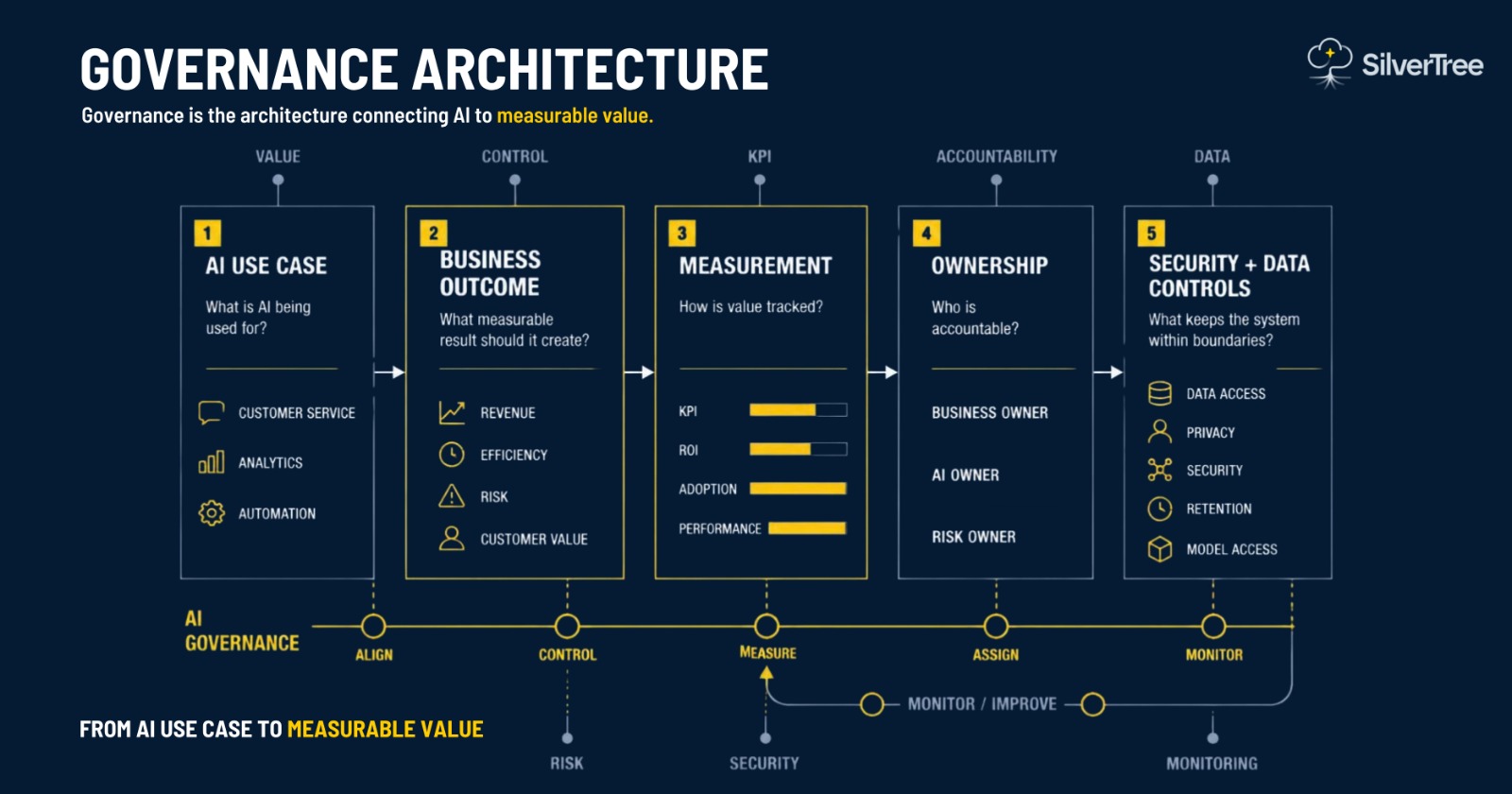
Governance is the architecture connecting AI to measurable value
Governance is often reduced to a policy document, an approval committee or a list of prohibited tools. That definition is too narrow to protect an AI investment.
For a mid-market organization, governance needs to answer four operational questions before significant deployment begins.
What are we trying to change? Every deployment demands a clear business outcome, not merely an IT objective. Lowering costs, cutting cycle times, expanding revenue, raising service quality, or improving decision precision are all straightforward to measure. "Deploy an AI assistant" cannot.
How will the outcome be measured? The baseline needs to exist before deployment. Without it, productivity claims remain anecdotal and financial impact becomes difficult to attribute.
Who owns the result? AI projects cross business and technology boundaries. Leadership matters far more than tech stack here. The companies getting real results from AI aren't just lucky, they’re managed differently.
McKinsey’s data shows high performers are two times more likely to show strong senior executive commitment and use structured methods to measure AI’s business impact (McKinsey, August 2026).
What constraints govern the deployment? Data access, security, human oversight, system integration and acceptable use need to be defined before the tool is selected, not after implementation creates a problem.
Real results require operational change, not extra subscriptions. Close to three in four AI high performers fundamentally overhaul their workflows around AI, versus just 25% for other companies.
They’re also 3.3 times more likely to aim for full business transformation over the next three years (McKinsey, August 2026).
Governance therefore determines more than what AI is allowed to do. It determines what the organization expects the investment to accomplish.
Before scaling an AI programme, a complimentary 10-point AI readiness assessment can establish the current state, governance gaps and measurable outcomes.
Security has to be designed into the AI programme
Don't treat security as a final review step after picking an AI tool. By that stage, key decisions on data sharing, system connections, and user roles are already locked in. That’s dangerous as AI drives core business tasks. McKinsey points out that high-performing companies actively manage AI-related threats, including code vulnerabilities and unauthorized or accidental actions (McKinsey, August 2026).
The MIT NANDA research points to the same operational reality from another direction. Its executive interviews identified trust, workflow understanding, minimal disruption to existing systems and clear data boundaries among the criteria leaders use when evaluating AI vendors. Respondents also emphasized the importance of systems that can improve over time while operating within defined guardrails (MIT NANDA Initiative, July 2025).
For a mid-market company, that means security decisions should happen alongside use-case definition and outcome planning.
Which information can the model access?
Which systems can it interact with?
Where is human approval required?
What happens when the model produces an incorrect result?
How are activity and exceptions monitored?
Silver Tree's positioning reflects this approach. Adopting AI safely means checking your setup first, throwing up hard rules, and deploying models without triggering fresh security or workflow fires. Safety isn't some extra coating; it's embedded right into how the business operates every day.
The practical consequence is straightforward. Security should constrain the design of an AI programme before deployment, not clean up the programme after deployment.
Governing first changes what happens after the pilot
MIT NANDA found a steep drop from investigation to implementation for task-specific AI tools, with only 5% reaching successful implementation in its research. It also found that top-performing mid-market companies moved from pilot to full implementation in an average of 90 days, compared with nine months or longer for enterprises in its sample (MIT NANDA Initiative, July 2025).
That speed is not simply about moving faster. It reflects having a defined use case, a decision owner, measurable success criteria and an operating environment capable of supporting the deployment.
The World Economic Forum's research reinforces why this matters for mid-market companies. Roughly one-third of private-sector GDP and jobs in developed economies come from these businesses. Still, historically only one out of seven US middle-market firms invested extra dollars in technology. Today though, cratering AI inference costs are opening up advanced capabilities for smaller businesses (World Economic Forum, January 2026).
The opportunity is therefore real, but so is the cost of getting the sequence wrong.
Silver Tree's approach is structured around See and Advise, Execute and Measure, Optimise and Lead. The first stage establishes the current state, strategy and measurable success criteria before technology selection. The second moves into execution while tracking against agreed outcomes and embedding security into the design. The third focuses on ongoing performance against business outcomes.
That sequence matters because an AI programme should not become harder to govern as it becomes more successful.
Silver Catalyst turns governance into an operating discipline
The Silver Catalyst methodology is built around the point at which AI programmes usually become difficult: moving from intention to accountable execution.
See and Advise starts with assessment. The objective is to establish the current state, identify the relevant business problem, define the strategy and set measurable success criteria before technology is selected.
Execute and Measure moves the programme into implementation. The focus is not activity for its own sake. It is whether the agreed business outcomes are being produced, measured and adjusted as the programme operates. Security is part of that execution rather than a separate workstream.
Optimise and Lead treats performance as an ongoing management responsibility. The programme is measured against business outcomes, not simply against deployment milestones.
That approach reflects Silver Tree's broader position that AI adoption must be structured, governed and tied to quantified business value rather than treated as a collection of pilots.
For a CEO, the distinction is consequential. An AI programme can have a budget, a vendor, a technical team and an impressive demonstration and still have no defensible ROI. Governance is what connects those resources to a number the business can actually manage.
Nobody is asking if governance delays progress. The uncomfortable choice is putting controls on investment today, or getting caught explaining how a failed pilot swallowed the budget without showing a single result.
FAQs
How should mid-market firms handle AI governance in practice?
To actually deliver value, it has to define clear business goals, concrete use cases, solid tracking metrics, joint business-IT accountability, data guardrails, security rules, and escalation steps.
Just as vital are straightforward rules for managing failing pilots, giving management a simple way to cut spending whenever an experiment falls flat. Good governance serves as an active decision framework to guide the business forward, not a static pile of policy documents.
Start with a baseline tied to the business process being changed. The metric might be cycle time, cost per transaction, revenue conversion, error rate, service volume or another operational measure.
McKinsey's August 2026 data shows why: while 80% of workers claim individual productivity gains, only 37% see a positive organizational EBIT impact.
When should security be included in an AI project?
Before tool selection and deployment. Factors like data access, identity, permissions, software integrations, human oversight, and tracking directly dictate which AI tools actually fit your needs. Saving security for a post-launch review forces teams to awkwardly retrofit controls onto systems never designed for them.
What does a Silver Catalyst AI assessment cover?
This assessment maps out where your operations are today, uncovers hidden bottlenecks, and sets hard targets before you commit any budget. It gives you a clean starting point for the See and Advise phase so you solve an actual operational problem instead of just buying another piece of software.
The AI investment is only as valuable as the operating model around it
Your AI investment is only as good as the operating model behind it. Getting access to AI is simpler, cheaper, and far more embedded in daily work. McKinsey’s survey shows 80% of workers report personal efficiency gains, with 60% expecting higher AI budgets next year. Yet a mere 6% rate as true AI high performers, while positive EBIT impact remains stalled at 37% (McKinsey, August 2026).
That is the governance gap.
The organizations that close it will not necessarily be the ones buying the most AI. They will be the ones willing to define the outcome before approving the spend, measure it after deployment and stop an initiative that cannot justify its continued investment.
If you are about to approve another AI investment, establish the governance and measurement architecture before the budget becomes sunk cost.

Darwin Herdman brings over 30 years of leadership experience in building, scaling, and optimizing managed service operations for a diverse range of organizations—including small and mid-sized businesses (SMBs), Fortune 100 enterprises, state and local governments, and tier-one telecommunications providers.
Throughout his career, Darwin has led high-impact initiatives that modernized IT service delivery, streamlined operations, and introduced automation frameworks at scale. His work spans every layer of the managed services stack, from service desk and infrastructure management to cloud operations, security services, and digital employee experience platforms.
Darwin's deep expertise in operational design, service orchestration, and technology transformation makes him uniquely qualified to articulate the vision and operational blueprint for Autonomous IT. His insights are grounded in decades of real-world execution, delivering measurable outcomes for some of the most complex and high-demand IT environments in North America.
