
Why 95% of AI Pilots Failed and Why CEOs Are Now Running the Playbook
The buyer for AI has changed. For most of the last two years, AI was a CIO conversation. Tools were evaluated, pilots were scoped, vendors were shortlisted. The CEO approved the budget and waited for results. Those results haven't come. MIT's NANDA Initiative reports that 95% of enterprise GenAI pilots delivered no measurable P&L impact. Gartner says half are abandoned after proof of concept. CIO Dive reports that 74% of CIOs regret a major AI vendor decision made in the past 18 months. So the CEO has taken the wheel. BCG's 2026 survey: nearly three out of four CEOs are now their company's chief decision maker on AI. The question they're asking has changed too. Not which tools to pilot. Which integrated partner can deliver outcomes across data, security, governance, talent, and operations so AI investment actually produces business results. We wrote a perspective on what that shift means for mid-market companies, why pilots stalled, and what the integrated operating model looks like in practice.
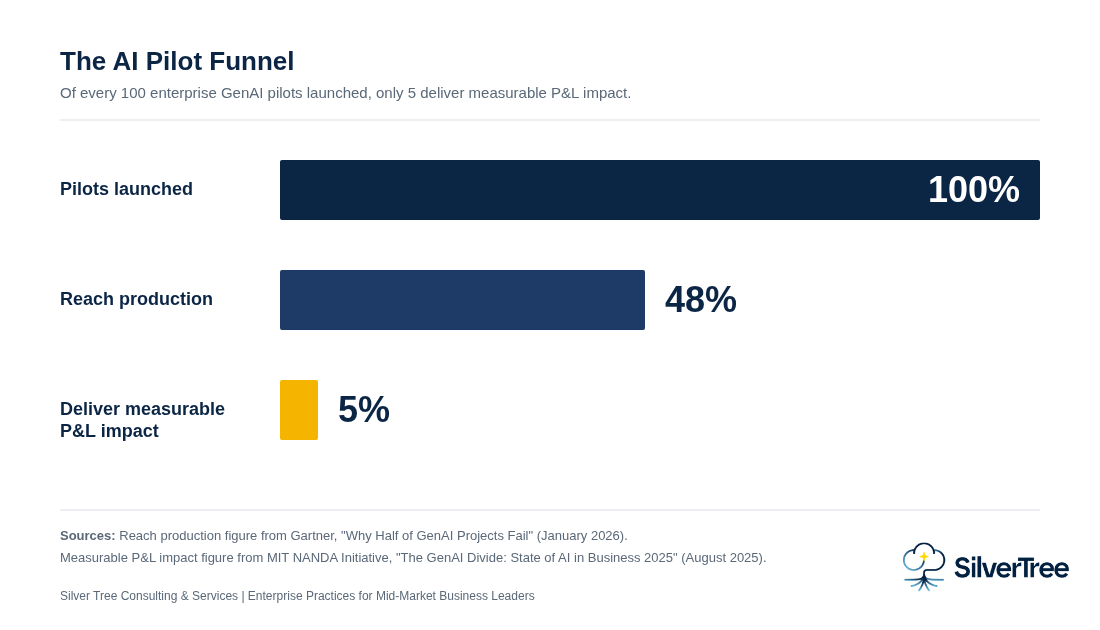
In August 2025, MIT's NANDA Initiative published a finding that landed harder than most AI research of the last two years. After studying enterprise GenAI investment across hundreds of companies, the researchers concluded that 95% of pilots had delivered no measurable P&L impact. The total spend behind that result was somewhere between $30 billion and $40 billion.
Gartner followed in January with its own update. Half of GenAI projects are now abandoned after proof of concept. Only 48% of AI projects ever reach production. The average prototype-to-production journey takes eight months.
For most of 2024, AI failure was a quiet problem. Pilots stalled, vendors pivoted, and budgets quietly rolled forward. By the end of 2025, the failure was loud, public, and on the board agenda.
The boards have responded. According to Harvard Law's Corporate Governance Forum, 72% of S&P 500 companies disclosed material AI risks in their 2025 10-K filings, up from roughly 12% in 2023. AI is no longer a technology line item. It is now a fiduciary topic.
And the CEO is the one answering the question.
The Buyer Has Changed
BCG's January 2026 CEO survey reports that nearly three out of four CEOs now identify themselves as their company's chief decision maker on AI. A year earlier, it was about one in three. Half of those CEOs believe their job depends on AI paying off.
This is the shift that explains everything happening downstream.
For most of the last two years, AI was a CIO and CTO conversation. Tools were evaluated, pilots were scoped, vendors were shortlisted. The CEO approved the budget and waited for results. Those results have not come, and the CEO is now in the seat that used to belong to the CIO.
The CIO is in a different seat. CIO Dive's coverage of the Dataiku and Harris Poll survey of 600 CIOs in February 2026 is worth reading in full. 98% report increased board pressure on AI ROI. 74% expect their role to be at risk within two years if AI does not deliver. 71% expect AI budgets to be cut or frozen by mid-2026 if targets slip. And 74% regret at least one major AI vendor decision made in the last 18 months.
Three out of four CIOs regret a major AI vendor decision. That number alone explains why the CEO has taken the wheel.
What Actually Went Wrong
The pilots that failed did not fail because the models were weak. The models worked. They wrote summaries, drafted emails, answered policy questions, generated code, and built dashboards. The failure happened in the layer underneath.
A regional manufacturer running a copilot pilot in finance discovered three months in that their AP data lived in four systems and that no one owned the master vendor record. The copilot summarized invoices well. It could not reconcile them.
A mid-sized professional services firm rolled out an internal AI assistant for proposal drafting and was forced to pull it back when the security team flagged that client data was flowing into prompts with no logging, no retention controls, and no audit trail. The pilot was technically a success. It could not pass an internal review.
A 600-person logistics company built a customer service chatbot that resolved 30% of tier-one tickets in testing. In production, agents stopped using the suggested responses within six weeks because the chatbot pulled from a knowledge base no one had updated since 2023.
These are the patterns. Fragmented data. Weak governance. No clear owner. No operating discipline around the work the AI was meant to do. Grant Thornton's April 2026 AI Impact Survey found that 78% of business executives lack confidence they could pass an independent AI governance audit within 90 days. The same survey found that 82% of CIOs say employees are building AI tools faster than IT can govern them.
Shadow AI is the symptom. The cause is structural. Mid-market companies have enterprise-level complexity across data, security, applications, and talent without enterprise-level operating models to manage it.
Integration Is the Differentiator
The same Grant Thornton study reported one finding that should reframe how every mid-market CEO thinks about AI investment. Organizations with fully integrated AI are nearly four times more likely to report revenue growth than those still piloting. 58% versus 15%. They are also ten times more likely to pass a governance audit.
Integration here means something specific. It means AI is connected to the business processes it improves, governed by the policies it must follow, supported by the data it depends on, and operated by people who own the outcomes. It is not a tool deployment. It is an operating capability.
This is the gap most mid-market companies cannot close on their own. They have lean IT teams already running the business. They have security teams stretched across compliance and incident response. They have data spread across systems that were never designed to talk to each other. Adding AI on top of that environment without addressing the foundation underneath produces exactly what the MIT report measured.
What the CEO Needs From a Partner
The question facing mid-market CEOs in 2026 has changed. It is no longer which AI tools to pilot. It is which partner can deliver outcomes across data, security, governance, talent, and operations so that AI investment actually produces business results.
That is a different procurement conversation. Five vendors for IT, security, AI, data, and talent leaves no one accountable when AI does not pay off. One partner with one operating model produces outcomes the board can see.
Silver Tree was built for this question. Our five capability areas (AI and Data, Security and Governance, Workforce, Intelligent Operations, and Applications and Modernization) sit under one roof, governed by the Silver Catalyst methodology. The AI360 Secure Portfolio brings together readiness, foundation, build, deployment, governance, reliability, and business process operations in one structured path. The outcomes our clients report are concrete: 25% to 40% reduction in manual effort in targeted workflows, 30% to 50% faster document review and processing, 90%+ reduction in shadow AI exposure, and one to two production-ready AI capabilities delivered in 6 to 10 weeks.
We bring enterprise discipline to mid-market AI adoption. We operate as a platform-agnostic partner, accountable for the work end to end.
The Decision in Front of You
The CEOs who will answer their boards well in 2026 are making one of two choices. Either they keep funding scattered pilots through the same operating model that produced the 95% failure rate, or they invest in the integrated foundation that converts AI ambition into measurable business results.
The clock CIO Dive identified is real. By mid-2026, 71% of AI budgets are at risk of being cut or frozen if targets slip. The window for showing the board something real is shorter than it was a year ago.
The CEO has the wheel. The question is what model is under the hood.
Ready to have the conversation your board is asking about? Book a complimentary AI readiness consultation with Silver Tree.
Silver Tree Consulting & Services helps mid-market organizations turn AI ambition into measurable business outcomes through an integrated approach across AI and Data, Security and Governance, Workforce, Intelligent Operations, and Applications and Modernization.


Richard Ricks is the founder of Silver Tree Consulting & Services and a veteran technology executive with decades of leadership experience in IT, outsourcing, and business transformation. A former CIO of Nortel Networks and senior executive at CSC, he has led large-scale technology and operational transformations for global organizations, delivering measurable business value through innovation, leadership, and disciplined execution.
