
When Operations Drag on Growth
AI tools don't create operational drag. Fragmented systems, reactive IT, and processes built for a smaller business do. This article examines where the ceiling comes from and what it takes to remove it.
64% of CFOs are planning for SG&A budgets to grow more slowly than revenue in 2026 (Gartner, October 2025). The mandate is clear: grow the business without growing the cost structure at the same rate. The problem is that most organizations issue that mandate without asking whether the operating model underneath is actually capable of it.
In practice, what that pressure produces is not efficiency. It is speed applied to a foundation that was never designed for scale. Approvals that already took too long now have fewer people to process them. Systems that were never integrated now have to support more decisions with less human coordination. IT teams that were already at capacity are being asked to govern AI tools that business units adopted without them.
The drag does not announce itself as a technology problem. It shows up in delivery timelines that slip by a few days every cycle. In reports that require manual assembly before every leadership meeting. In the CIO presenting a roadmap to the board while simultaneously managing a backlog that grows faster than the team can clear it. At a certain point, the operating model stops being the engine of growth and starts being the ceiling on it.
This article examines what creates that ceiling at the technology and process layer, why it compounds under growth pressure, and what it takes to redesign it without adding headcount or complexity.
Key Takeaways
- 64% of CFOs plan for SG&A budgets to grow more slowly than revenue in 2026, signaling that operational efficiency, not just top-line growth, defines success this year (Gartner, October 2025).
- Mid-market companies with less-structured internal processes and lower operational maturity are measurably more vulnerable to both performance drag and external shocks than their enterprise counterparts (McKinsey, April 2026).
- Organizations that solve integration and data access challenges achieve 10.3x ROI from AI initiatives, versus 3.7x for those with poor connectivity, a gap that compounds with every new technology added (MuleSoft, 2025).
- Only 6% of organizations qualify as AI high performers with 5% or more EBIT impact, and the gap between those companies and everyone else is widening because high performers addressed their operational foundation first (McKinsey, November 2025).
TL;DR
Growth pressure and operational drag are arriving at the same time for most mid-market companies. Leaders are being asked to do more with the same headcount, the same systems, and the same operating model that was built for a different pace. The problem is not ambition. It is that reactive, fragmented operations create a structural ceiling on what a company can actually deliver. This article examines where that drag typically lives, what it costs, and what it takes to remove it without adding complexity.
If your operations feel like they are working against your growth, Darwin Herdman offers a complimentary Advisory Session to walk through where the ceiling is and what to address first. Request a session
The Pressure Is Real. The Operating Model Often Isn't Built for It.
Think about what happens when a mid-market company wins a significant new client. Leadership celebrates. The operations team quietly recalculates. Who handles onboarding? Which system tracks deliverables? Which team owns the handoff between sales and delivery? If those answers require a meeting to determine, the operating model is already lagging behind the revenue.
This is the version of growth that does not show up in the press release. Revenue increases. Headcount holds flat by design. But the volume of coordination work, the manual handoffs, the exception handling, the decisions that require three emails to resolve — all of it increases with every new client, every new product, every new hire. The business grows. The operational complexity grows faster.
Less-structured internal processes, lower risk-management maturity, and the limited professionalization of key roles leave mid-market companies more vulnerable to both performance drag and operational shocks than large enterprises, according to McKinsey research published in April 2026. That vulnerability does not stay contained to delivery. It shows up in how fast leadership can make decisions, how reliably the business can execute on its commitments, and how much of the CIO's capacity gets consumed managing the current state rather than building toward the next one.
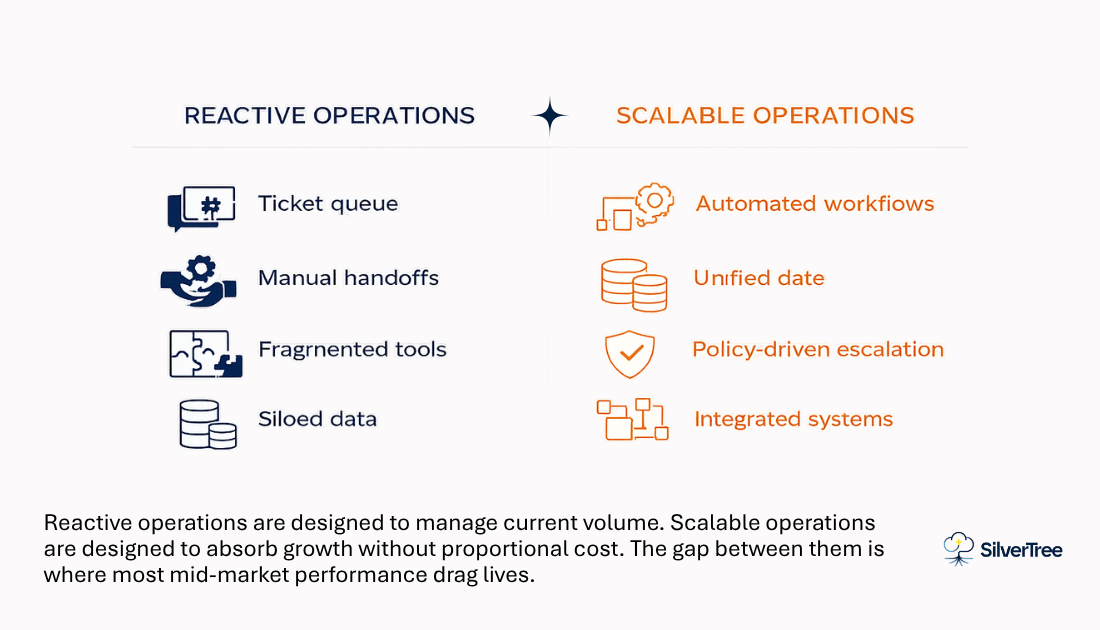
The technology layer reflects exactly this. Systems were added as needs arose, not as part of a unified architecture. Each one solved a problem at the time it was purchased. Collectively, they created an environment where data lives in silos, workflows break at handoff points, and the people who most need information are the ones spending the most time hunting for it.
Fragmented Systems Are a Growth Problem, Not an IT Problem
Take a common scenario: a COO wants to know the margin on a specific client account before a quarterly business review. That number exists. It lives across three systems — the CRM, the project management tool, and the finance platform — none of which share data automatically. Someone builds a spreadsheet. It takes half a day. By the time the meeting happens, the number is already two weeks old.
That is not a reporting problem. It is an integration problem that creates a business consequence: decisions get made on stale data, or they get delayed until the data can be assembled. Multiply that across every leadership decision in a quarter and the cumulative cost becomes material.
Organizations average 897 applications but only 29% are integrated, according to MuleSoft's 2025 Connectivity Benchmark. Each disconnected system is an island that forces human coordination to substitute for automated data flow. Organizations lose an average of 25% of revenue annually due to quality-related inefficiencies and poor decisions, according to Precisely's 2025 Data Integrity Trends Report. That figure compounds with scale. A $200M business absorbing 25% efficiency drag is leaving $50M of potential on the table before a single growth initiative is funded.
The technology implication is direct. Companies with strong integration achieve 10.3x ROI from AI initiatives versus 3.7x for those with poor connectivity (MuleSoft, 2025). Every AI tool deployed on top of a fragmented data environment operates at a fraction of its potential. The capability of the model is not the variable. The accessibility of the data it needs to work with is.
Reactive IT Is a Growth Constraint Disguised as a Support Function
Here is the conversation that plays out in most mid-market leadership teams at some point. The CFO wants a real-time view of operational cost by business unit. The COO wants to automate a client onboarding workflow that currently requires four people and two weeks. The CEO wants to know which AI tools the company is using and whether any of them carry data risk. All three requests land on the same IT team that is already managing a ticket backlog, preparing for a security audit, and onboarding three new SaaS tools that different business units purchased independently.
This is not a resourcing failure. It is a model failure. IT in reactive mode is measured on uptime and ticket resolution. Those are the right metrics for a maintenance function. They are the wrong metrics for a function that is now expected to govern AI adoption, build integrations, monitor data flows, and deliver infrastructure that supports growth, simultaneously, with flat headcount.
Companies appear to be leaning into technology more intentionally than ever, with AI cited as both a key investment area and a key operational challenge (Wells Fargo Middle Market Indicator, Year-End 2025). The pressure on the IT function has never been higher. But the operating model for most IT teams has not changed to match it.
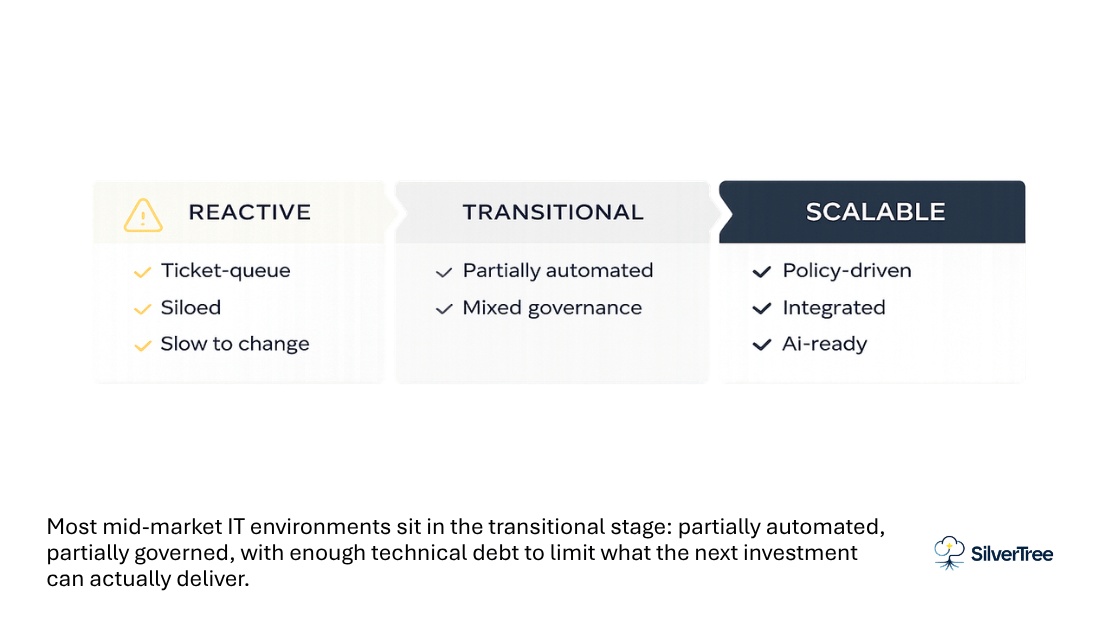
The business consequence is predictable. Business units route around IT to move faster. Shadow systems appear. AI tools get adopted without security or governance review. Manual processes fill the gaps that integrations would otherwise close. The CIO's credibility erodes not because the team is underperforming, but because the model asks them to run a reactive support function while the business needs a proactive operational capability. Those are different jobs.
The Operational Foundation Determines What AI Can Do
A mid-market professional services firm purchases an AI tool to automate contract review. The vendor demo was convincing. The procurement decision took three weeks. The implementation took six months and delivered half the expected value. The reason was not the tool. The contracts lived across four different document repositories, none of which were organized consistently. The metadata was incomplete. The access permissions were inconsistent across offices. The AI had nothing clean to work with.
This is the pattern. The business problem is real: contract review takes too long and consumes senior attorney time. The technology solution exists. But the operational foundation required for that solution to function was never built.
Only 6% of organizations qualify as AI high performers with 5% or more EBIT impact, and the gap between those organizations and everyone else is widening (McKinsey, November 2025). What separates them is not the sophistication of the models. It is the conditions those models were deployed into: structured data, integrated systems, clear governance, and workflows designed to act on what AI surfaces rather than simply receive its output.
High-performing organizations dedicate 70% of AI investment to people, processes, and operational transformation; 20% to data and technology infrastructure; and 10% to models and algorithms (McKinsey, 2025). The organizations that invert that ratio, buying models first and expecting the operational foundation to sort itself out, consistently see lower returns, higher implementation costs, and AI deployments that cannot scale beyond the pilot.
The technology decision is downstream of the operational decision. Getting the foundation right is not a delay. It is the work that determines what the technology can actually do.

What a Scalable Operating Model Actually Looks Like
Operational drag is not resolved by working harder or hiring more. It is resolved by changing the design of how work flows through the organization.
For mid-market companies, that means identifying where manual handoffs exist and automating them. It means consolidating systems so that data flows between functions without reconciliation. It means defining clear ownership for AI tools and establishing governance before adoption outpaces oversight. It means building monitoring and reporting into operations so that leadership has real-time visibility into where the model is performing and where it is not.
None of that is exotic. It is disciplined operational architecture applied to the specific environment a mid-market company actually operates in. A Strategic Capacity Model repositions capacity as an operating advantage: enabling growth without drag, and ambition without rework.
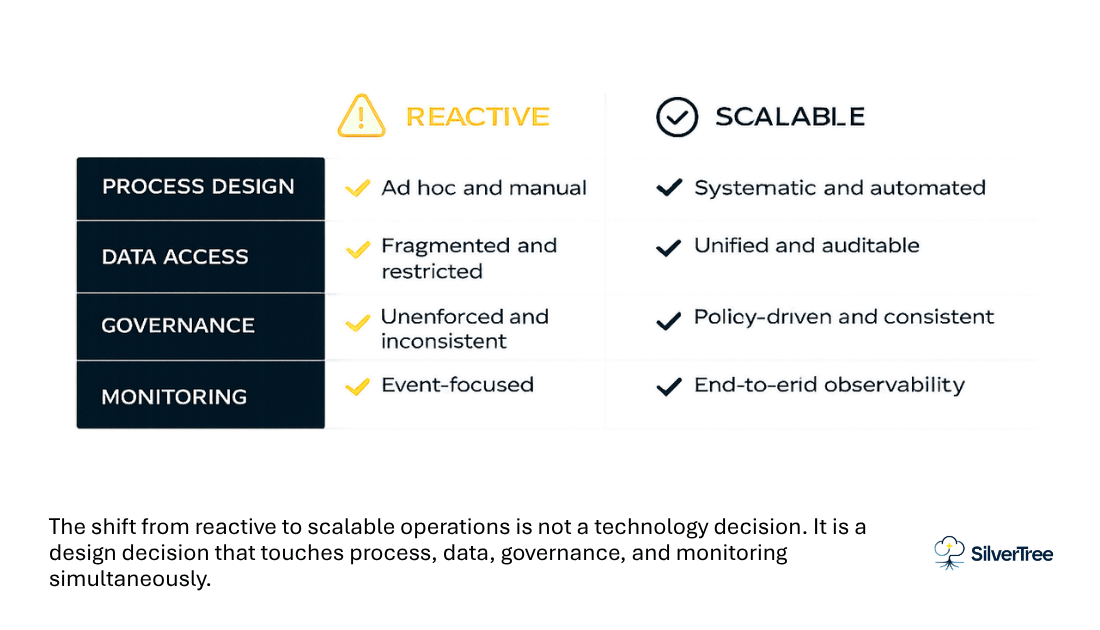
The organizations that execute on this consistently share one characteristic: they treat operational improvement as a permanent capability, not a recovery project. They are not reactive to drag. They build systems that prevent it from accumulating.
That is the difference between an operation that scales with growth and one that becomes the ceiling on it.
Frequently Asked Questions (FAQs)
How do I know if operational drag is limiting our growth?
The clearest signals are recurring process breakdowns during high-demand periods, manual workarounds that have become standard practice, decisions that consistently wait on data that should be available, and IT requests that backlog faster than they are resolved. If growth creates more internal coordination work rather than more output, that is operational drag. A complimentary Advisory Session with Darwin Herdman can give you a structured view of where it lives and what it is costing you.
What is the difference between operational efficiency and operational scalability?
Efficiency is doing the same work with fewer resources. Scalability is increasing output without proportional increases in resources or complexity. Most mid-market improvement efforts focus on efficiency — reducing cost in an existing process. Scalability requires changing the design of the process itself: automating handoffs, integrating systems, and building governance that does not require manual oversight to function. Both matter, but scalability is what allows growth to compound rather than stall.
Why does operational drag get worse as the company grows?
Because growth adds volume to processes that were designed for a smaller scale. Manual handoffs that worked at 150 employees create backlogs at 500. Systems that were adequate when the company had five product lines cannot support fifteen. Every growth milestone adds pressure to processes that were not designed to absorb it. Companies that do not redesign their operating model as they scale end up with a ceiling that they hit repeatedly, at every stage of growth.
When is the right time to address the operational foundation?
Before it becomes a constraint. The organizations that address it proactively, while the footprint is still manageable, have a significantly easier path than those that try to restructure under performance pressure. An Advisory Session with Darwin Herdman is designed to identify the highest-priority gaps and outline a remediation roadmap that matches your organization's current capacity for change.
Book a Complimentary Advisory Session with Darwin Herdman
Operations that were built to manage stability are now being asked to support growth. The gap between those two demands is where most mid-market performance problems live, and most of them are visible well before they become critical.
Darwin Herdman, CI&SO at Silver Tree, works directly with mid-market CIOs, COOs, and operations leaders to identify where operational drag is limiting delivery, what the highest-priority changes are, and what a scalable operating model looks like for their organization specifically. The session is conversational, structured, and specific to your environment.
Request a complimentary Advisory Session with Darwin


Darwin Herdman brings over 30 years of leadership experience in building, scaling, and optimizing managed service operations for a diverse range of organizations—including small and mid-sized businesses (SMBs), Fortune 100 enterprises, state and local governments, and tier-one telecommunications providers.
Throughout his career, Darwin has led high-impact initiatives that modernized IT service delivery, streamlined operations, and introduced automation frameworks at scale. His work spans every layer of the managed services stack, from service desk and infrastructure management to cloud operations, security services, and digital employee experience platforms.
Darwin's deep expertise in operational design, service orchestration, and technology transformation makes him uniquely qualified to articulate the vision and operational blueprint for Autonomous IT. His insights are grounded in decades of real-world execution, delivering measurable outcomes for some of the most complex and high-demand IT environments in North America.
