
The Hire You Can't Fill Is the Reason Your Initiative Is Behind
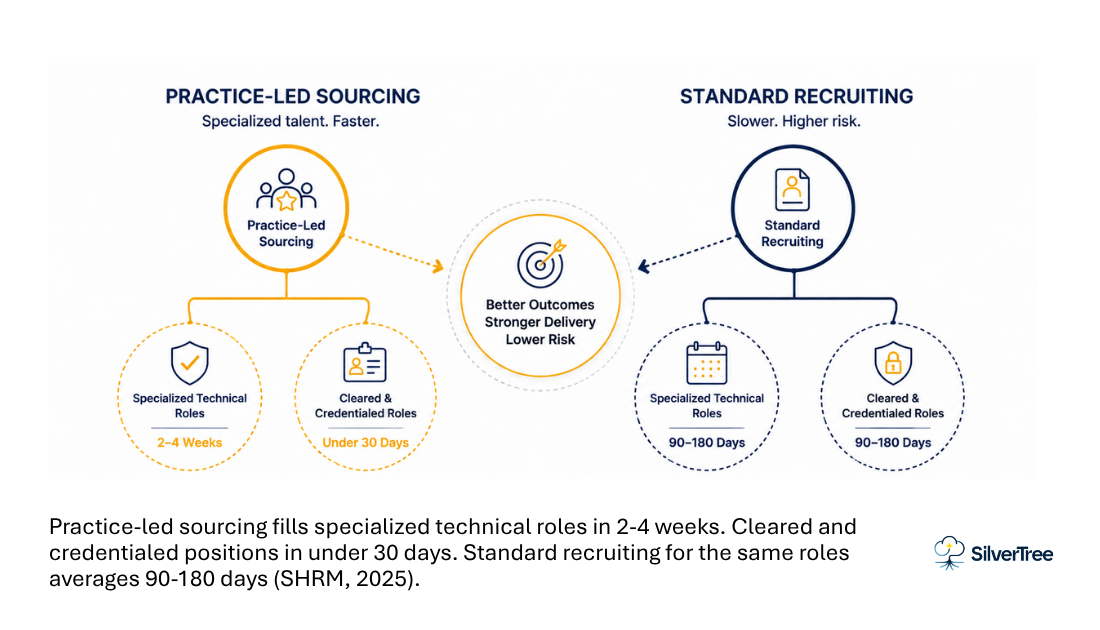
Most mid-market programs stall not because the strategy is wrong but because the right person was never in the seat. Standard recruiting is optimized for volume and speed on common roles. It breaks down on security architects, cleared data scientists, AI engineers with production experience, and platform leads who can operate inside a complex stakeholder environment. The fix is not a faster recruiter. It is a firm whose practitioners already know what the role requires because they run the programs. Mid-market companies that shift to practice-led talent sourcing fill specialized roles in 2-4 weeks instead of 3-6 months, and save 20-40% on talent costs compared to full-time hiring.
Key Takeaways
- Specialized and senior technical roles take 90 to 180 days to fill through standard recruiting channels, with cleared or credentialed roles running six months or longer (SHRM Talent Acquisition Benchmarking Report, 2025).
- 84% of companies report significant skills gaps in their organizations, with AI and ML roles taking an average of 89 days to fill due to talent scarcity (Second Talent, May 2026).
- 70% of technology leaders say the AI factor alone has made them more likely to work with a specialized firm to fill technical roles, and 93% of those who did say it was effective (Robert Half Demand for Skilled Talent Report, 2026).
- Mid-market companies using flexible workforce models achieve 20-40% cost savings vs. traditional full-time hiring when accounting for salary, benefits, bench costs, attrition, and recruiting latency (Silver Tree client data, 2025).
The initiative is approved. The budget is committed. The executive team is aligned. Then the program doesn't move.
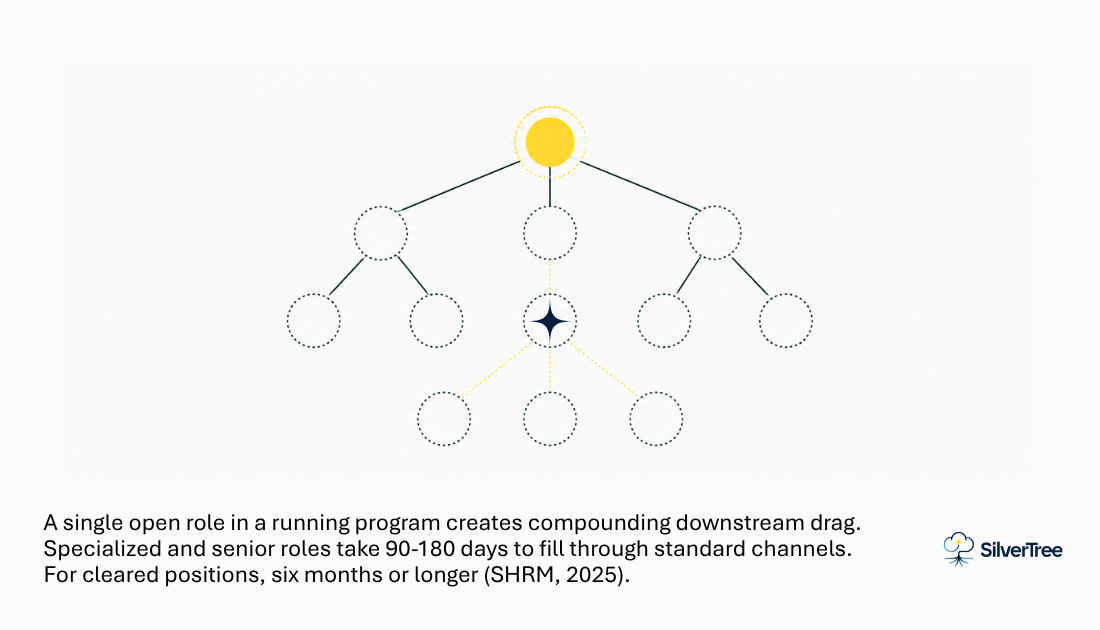
I have encountered this so many time during my tenure, first during 23 years at Nortel, the last three as CIO, then across seven years as Group President at CSC overseeing a $6.5B global outsourcing business, and now across 11 years building Silver Tree. The common thread is never a flawed strategy. It is a single unfilled role that the wrong sourcing process was never going to find. Specialized and senior technical positions take 90 to 180 days to fill through standard recruiting channels. Cleared or credentialed roles run six months or longer (SHRM, 2025). For a mid-market company running a 90-day initiative, that math doesn't work.
General Recruiting Was Not Built for This Kind of Role
Standard recruiting is optimized for volume, speed, and common role profiles. Recruiters work from job descriptions, match keywords, and move fast. That process works well for a project manager who needs PMP certification and five years of experience, or an IT support lead who can run a service desk. It does not work for an AI engineer who needs production deployment experience in regulated environments, a security architect who needs to understand NIST AI RMF alongside cloud security posture, or a data scientist who needs a security clearance plus domain expertise in pharmaceutical manufacturing.
84% of companies now report significant skills gaps in their organizations. AI and ML roles alone are taking an average of 89 days to fill due to talent scarcity (Second Talent, May 2026). Security roles reached 66,800 job postings in 2025, up 124% year over year, with demand far outpacing available cleared and credentialed candidates (Robert Half, 2026). A general recruiter working from a job description is competing for the same thin pool, using the same job boards, and delivering the same profiles that do not quite fit.
The result is a role that stays open for months, a program that milestones around the gap, and a CEO explaining to the board why the initiative is behind schedule.
The problem is not that the right people do not exist. It is that a general recruiter cannot get to them. The role requires someone who knows what the job actually demands, not someone who knows how to post it.
The Cost That Does Not Show Up in the Recruiting Budget
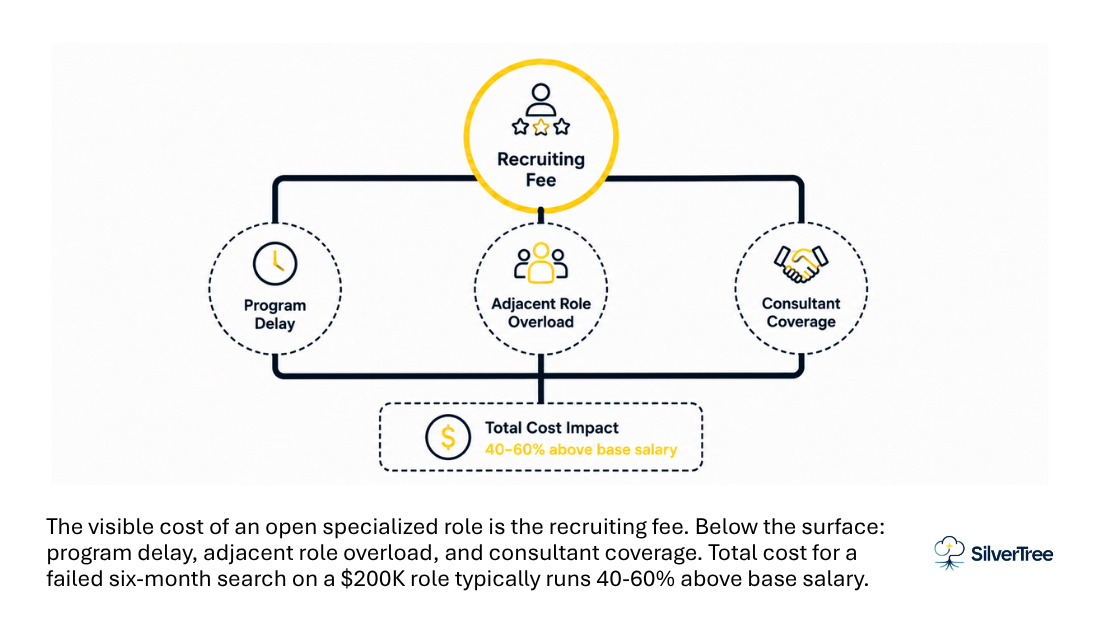
Mid-market CFOs tend to see the recruiting fee as the cost of a bad hire or a slow search. The actual cost is bigger and less visible. Consider what happens when a specialized technical role sits open for 90 days inside a running program. The team that was scoped to deliver with that role in place works around the gap. Milestones move. The roles adjacent to the open seat carry extra load and sometimes turn over. A consultant gets hired to cover partial scope at a higher hourly rate than the full-time hire would have cost.
When you account for salary and benefits of a full-time hire, bench costs during ramp-up, management overhead, attrition and backfill costs, and recruiting latency, mid-market companies using flexible workforce models consistently show 20-40% cost savings compared to traditional full-time hiring (Silver Tree client data, 2025). That is not a rounding difference. On a $200K technical role, the gap between a well-structured flexible engagement and a failed full-time search is often six figures in direct cost, before the program delay is factored in.
SHRM reports that the average cost per hire is now $5,475 for non-executive roles and $35,879 for executives, up 21% since 2022 (SHRM, 2025). For cleared or highly specialized positions, those figures are considerably higher. The recruiter's fee is a fraction of what the delay costs.
Book a Complimentary Business Performance Assessment
Silver Tree works with mid-market CEOs and CHROs on the specific roles and programs where standard sourcing has already failed. The assessment takes 60 minutes and produces a clear picture of where the talent gap is creating program risk.
Practice Expertise Changes What the Search Looks Like
When Silver Tree was founded in 2014, Workforce Solutions was the business. Not a supporting service. The business. I built it after spending two decades watching the same problem play out across Nortel and CSC: the organizations that executed fastest had the right people in the right seats. The ones that stalled were almost always waiting on a role that a general recruiter could not fill.
Every practice Silver Tree has built since, AI, data, security, IT operations, was built on top of a workforce capability that already worked. That means when a client comes to us with an AI program that needs a data scientist with security clearance, the AI practice team defines what that person needs to be able to do. They know because they run AI programs. When a law firm needs a ServiceNow lead who can navigate a high-stakes partner environment, the team screening candidates has worked inside professional services firms. The job description is not the brief. The program requirements are.
70% of technology leaders say the AI factor alone has made them more likely to work with a specialized firm for technical hiring. 93% of those who did say the firm was effective (Robert Half, 2026). The shift from a general recruiter to a firm with practice expertise is not a preference. It is a structural difference in what the search can access.
What It Looks Like When the Model Works
A defense AI company came to Silver Tree after their internal recruiting had stalled for months on a cleared ML specialist role. The role required a security clearance, production ML deployment experience, and domain knowledge in a regulated environment. The incumbent recruiting vendor had run the search for five months. Silver Tree placed the candidate in under 30 days. The program moved.
A large law firm needed to build a full ServiceNow leadership team for a complex implementation. The incumbent vendor had been working the search for four months. Silver Tree assembled the team in 30 days. The difference was not speed as an operational virtue. It was that Silver Tree understood what the roles required inside that specific client environment.
A national nonprofit transitioned to a managed workforce model for its IT function across 20 locations. $1 million in annual savings. 100% of SLAs met over five years. CSAT improved from 2.5 to 4.5. The outcome was not a product of a single great hire. It was a model built around the right engagement structure from the start.
The Right Engagement Model Depends on What the Program Actually Needs
Not every talent problem is a single-hire problem. Some programs need one specialist in the seat by next month. Others need a team that can operate semi-independently on a 12-month initiative. Others need fractional executive leadership, a CIO or CISO who can set direction without the overhead of a full-time hire.
Matching the engagement model to the program requirement is a decision that most mid-market companies make by default rather than by design. The default is a full-time hire because that is what HR is set up to process. The result is a 90-day search for a role that might be better structured as a six-month contract, an augmented team arrangement, or a build-operate-expand model where capability transfers internally over time.
The starting question is not which recruiter to use. It is what the program requires, on what timeline, and what the CFO will approve. The engagement model follows from those three answers. The talent sourcing follows from the model.
The programs that move are the ones where someone asked those questions before the search started.
Frequently Asked Questions (FAQs)
Why do specialized technical roles take so long to fill through standard recruiting?
Standard recruiting is built for volume and common role profiles. It works well for roles where the job description maps cleanly to a large candidate pool. Specialized technical roles, cleared positions, and roles that require a combination of credentials and domain expertise have thin candidate pools, and finding the right person requires knowing what the role actually demands, not just what the job description says. A firm whose practitioners run these programs has a fundamentally different starting point for the search than a general recruiter working from a job description.
How much does a stalled program actually cost?
The visible cost is the recruiting fee. The real cost includes program delay, adjacent role overload, consultant coverage at higher hourly rates, and the compounding effect of missed milestones. For a $200K specialized technical role, the total cost of a six-month failed search through standard channels, including those downstream costs, typically runs 40-60% above base salary. Mid-market companies that shift to flexible workforce models consistently report 20-40% savings compared to full-time hiring across the full engagement lifecycle (Silver Tree client data, 2025).
What is practice-led vetting and why does it matter?
Practice-led vetting means the team screening candidates for a role has direct expertise in the domain that role covers. At Silver Tree, AI candidates are reviewed by the AI practice team. Security candidates are reviewed by the SecOps practice. That means the screening criteria are set by people who know what the job actually requires, not by a recruiter reading a job description. The result is a higher-quality shortlist that moves to a decision faster. It also means that cleared or credentialed roles, which a general recruiter typically cannot assess, are sourced and screened by people who can.
How do I know which engagement model is right for my program?
The right model depends on three questions: what the program requires, on what timeline, and what your CFO will approve. A single urgent hire needs a different model than a 12-month AI program that requires a team with a build-operate-expand structure. A fractional CIO engagement looks different from an augmented team of three embedded specialists. Silver Tree's Business Performance Assessment is structured to answer those questions in 60 minutes and produce a recommendation on which model fits. It is a useful starting point before a search begins.


Richard Ricks is the founder of Silver Tree Consulting & Services and a veteran technology executive with decades of leadership experience in IT, outsourcing, and business transformation. A former CIO of Nortel Networks and senior executive at CSC, he has led large-scale technology and operational transformations for global organizations, delivering measurable business value through innovation, leadership, and disciplined execution.
