
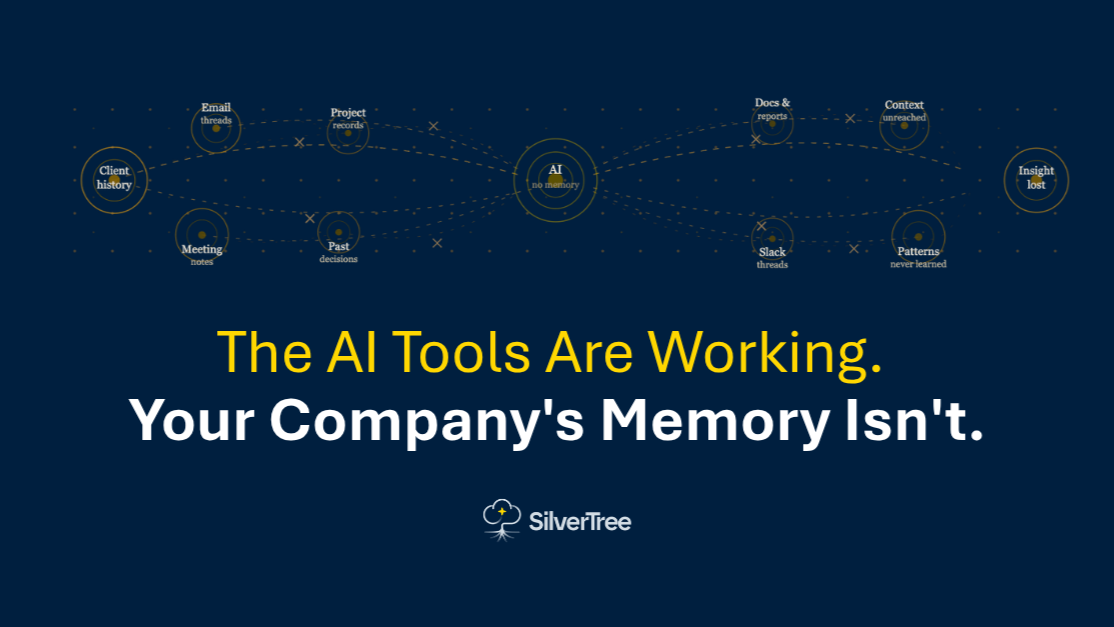
The AI Tools Are Working. Your Company's Memory Isn't.
AI tools cannot compensate for what your organization has never captured. Dan Hou of Eskridge calls it the missing layer: institutional memory. The knowledge of how your business works, what it has learned, and what it has already decided. Without it, every AI deployment starts from scratch. This article examines why that gap is costing mid-market companies more than any model limitation, and what it takes to fix it before the next investment compounds the problem.
This article draws on insights from Dan Hou's original piece, "Institutional Memory: AI's Missing Layer", published by Eskridge. Dan Hou is Founder of Eskridge and an advisor to Silver Tree. His analysis has been adapted here for mid-market CEOs.
Most mid-market CEOs are asking a version of the same question right now: we have invested in AI tools, so why aren't we getting more out of them?
The answer, more often than not, has nothing to do with the tools themselves.
Dan Hou, founder of Eskridge and an advisor to Silver Tree, recently named what may be the most important and underappreciated barrier to AI value in business: the absence of institutional memory. Not better data. Not smarter models. Memory. The accumulated knowledge of how your organization actually works, what it has learned over time, and what decisions it has already made.
In a recent piece for Eskridge, Hou pointed to a revealing signal from inside one of the world's most well-resourced AI labs. When Anthropic's source code was inadvertently exposed in early 2025, researchers discovered a near-finished internal feature called KAIROS, a persistent memory system designed to consolidate knowledge across sessions, resolve contradictions, and build structured context over time. It was referenced over 150 times in the codebase, already built, just waiting for a green light.
As Hou writes, this tells us where leading AI researchers believe the real bottleneck is. Not reasoning power. Not autonomy. Memory.
What's Actually Happening Inside Your Organization
Here is the situation many mid-market companies are in right now. AI tools have been deployed across functions, sales, operations, customer service, finance, but every time one of those tools runs, it starts from scratch. No memory of last week's client conversation. No awareness of the strategic decision made six months ago. No accumulated understanding of what makes your business work.
Hou describes these systems plainly as "very fast amnesiacs."
The cost compounds quietly. Think about what your organization has earned over the years. Deep knowledge of your customers. Hard-won process wisdom. Domain expertise. Competitive intelligence gathered deal by deal. Now ask honestly: how much of that knowledge is actually structured and accessible? Not stored in someone's head. Not buried in a Slack thread or a year-old email chain. Accessible, to your team, and now increasingly to the AI tools that are supposed to make them more productive.
McKinsey research cited by Hou found that knowledge workers spend roughly 20% of their working time simply searching for internal information. That is a full day, every week, lost to organizational amnesia. For a mid-market company running a lean operation, that is a structural drag on every team in the building.
Why This Has Stayed Off the CEO's Radar
Knowledge management has been on the enterprise agenda for decades. As Hou observes, it was always treated as a secondary priority, important in theory, underfunded in practice, and displaced by whatever felt more urgent that quarter.
What has changed is who now needs that knowledge.
When human employees were the only ones drawing on institutional knowledge, poor management of it created friction. Slower onboarding. Duplicated work. Expertise that walked out the door with a retiring colleague. Those costs were real, but diffuse enough to absorb.
Now your AI agents are also trying to consume that same knowledge, and they have no tribal memory or intuition to fall back on. They either have structured access to what your organization knows, or they operate blind. That changes the math entirely.
For mid-market CEOs, this lands in a specific way. You do not have the buffer that large enterprises carry when AI deployments underperform. When 95% of AI pilots fail to scale beyond proof of concept, as MIT research has found, the cause is rarely the model. The cause is the organizational conditions the model was deployed into. Institutional memory is one of the most critical of those conditions.
Four Principles Worth Acting On
Hou identifies four principles that translate directly to mid-market decision-making.
- Institutional memory is a compounding asset. Every client interaction, every project, every internal decision your organization makes has the potential to enrich a shared knowledge layer that makes the next decision faster and smarter. Organizations that structure this now will be harder to compete with in three to five years. Those that do not will keep reinventing the wheel, just faster.
- Own your memory layer. The major AI providers, Anthropic, OpenAI, Google, are all racing to fill the memory gap with their own proprietary solutions. For individual users, that is convenient. For a business, it creates a serious risk. If your organizational knowledge, your client context, your accumulated intelligence ends up living inside an AI vendor's infrastructure, you have created the deepest form of lock-in imaginable. Switching providers no longer means changing a contract. It means starting your organizational brain from scratch. Your institutional memory must live in systems you own and control, your CRM, your project management tools, your document repositories, your knowledge base.
- Make your data reachable. Most mid-market organizations already have institutional memory. The problem is that it sits inside systems that were never designed for AI access. Your CRM holds decades of client knowledge. Your project management tool holds delivery history. Your financial systems hold operational intelligence. The question is whether those systems are accessible to the AI tools that increasingly need them. For most organizations today, the answer is no, and every AI tool deployed on top of that inaccessible foundation is operating at a fraction of its potential value.
- Treat memory as infrastructure, not a project. The conversation about AI returns tends to focus on task-level speed: contracts reviewed faster, reports generated more quickly. The bigger opportunity is building a memory layer that gets richer with every use, where each client interaction, each decision, each project outcome feeds back into a shared knowledge base that every subsequent task can draw on. That is infrastructure. And it compounds.
A Question Worth Asking Before the Next AI Investment
Silver Tree works with mid-market companies across every stage of AI adoption. One of the most consistent findings across those engagements is that the gap rarely comes from the AI itself. The gap comes from what the AI has access to.
Before the next tool purchase or pilot launch, consider asking a more foundational question: what does my AI actually know about how this business works, and where does that knowledge live?
If the honest answer is that it lives in people's heads, email threads, and meeting recordings that no one has indexed, then more capability in the model will not close the gap. As Dan Hou puts it, the bottleneck is memory.

This article draws on Dan Hou's original analysis, "Institutional Memory: AI's Missing Layer," published by Eskridge. Dan Hou is Founder of Eskridge and an advisor to Silver Tree Consulting & Services. Silver Tree helps mid-market companies build the organizational conditions needed to turn AI investment into measurable business outcomes.


Darwin Herdman brings over 30 years of leadership experience in building, scaling, and optimizing managed service operations for a diverse range of organizations—including small and mid-sized businesses (SMBs), Fortune 100 enterprises, state and local governments, and tier-one telecommunications providers.
Throughout his career, Darwin has led high-impact initiatives that modernized IT service delivery, streamlined operations, and introduced automation frameworks at scale. His work spans every layer of the managed services stack, from service desk and infrastructure management to cloud operations, security services, and digital employee experience platforms.
Darwin's deep expertise in operational design, service orchestration, and technology transformation makes him uniquely qualified to articulate the vision and operational blueprint for Autonomous IT. His insights are grounded in decades of real-world execution, delivering measurable outcomes for some of the most complex and high-demand IT environments in North America.
