
How Mid-Market Companies Are Managing Cost Pressure and Operating Drag in 2026
84% of mid-market companies are prioritizing cost optimization in 2026 while simultaneously managing rising labor costs, talent gaps, and technology pressure (CBIZ, Feb 2026). Economic uncertainty is structural. 43% of US CEOs rank it as their top external threat and conditions are not expected to stabilize before year end (Conference Board, Jan 2026). The constraint facing mid-market leaders is operating capacity. Those who close that gap with enterprise-grade discipline protect margin. Those who do not lose it quietly.
Key Takeaways
- 84% of mid-market companies are prioritizing cost optimization and productivity this year, while simultaneously investing in talent and technology (CBIZ Q1 2026 Mid-Market Pulse, Feb 2026).
- 43% of US CEOs rank economic uncertainty as their top external threat for 2026. Only 39% are optimistic about the national economy, even while remaining confident in their own operations (Conference Board C-Suite Outlook, Jan 2026; JPMorgan Business Leaders Outlook, Jan 2026).
- 46% of US CEOs say measuring AI ROI is their top AI priority, yet mid-market companies typically lack the data governance infrastructure to assess what is actually returning (Conference Board, Jan 2026).
- CEOs who govern on evidence run companies 20% more profitably. That gap compounds into enterprise value (Silver Tree Corporate Overview, May 2026).
Mid-market CEOs heading into the second half of 2026 are carrying the same impossible brief: cut costs, grow revenue, fill critical roles, modernize technology, and do it all without the budget or bench strength of an enterprise. CBIZ surveyed more than 1,300 mid-market businesses this February and found 84% are prioritizing cost optimization and productivity as their top initiative this year. The same survey found 43% are simultaneously investing in talent acquisition and retention. Both at once.
That is not a contradiction. It is the operating reality of running a mid-market company in 2026. The leaders who understand what is actually driving that pressure, and where it is costing them the most, are the ones who will exit this year with margin intact.
Mid-Market Leaders Are Confident in Their Own Businesses and Pessimistic About the Economy
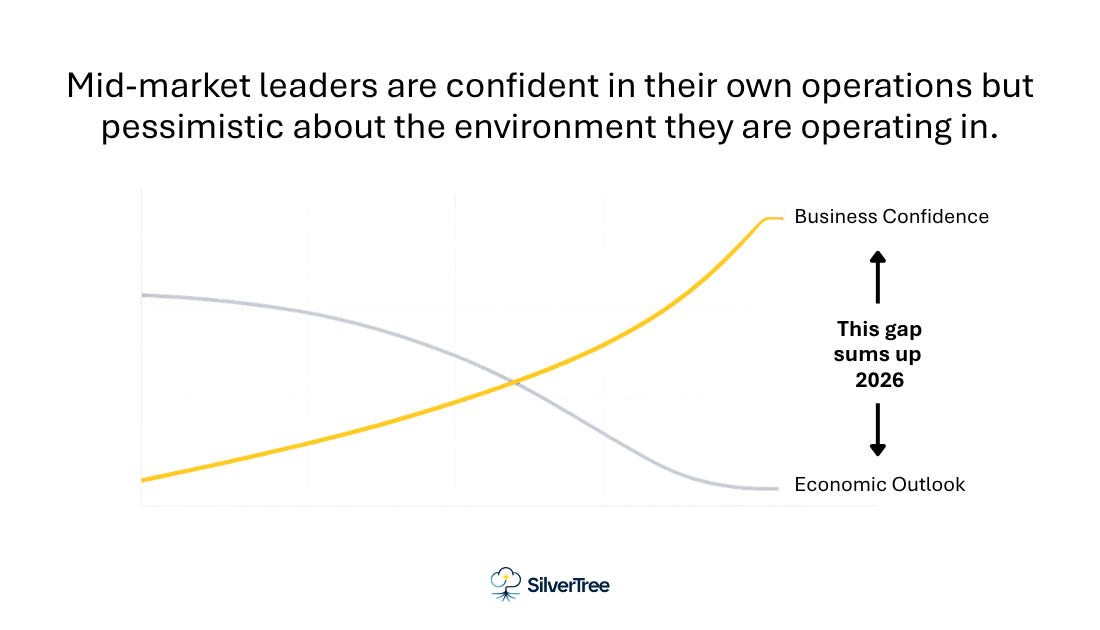
JPMorgan's 2026 Business Leaders Outlook found mid-market leaders remain confident in their own operations, but only 39% are optimistic about the national economy. That gap is not irrational. It reflects the tension between what a well-run company can control internally and what it cannot control externally. Tariffs, labor costs, inflation, and interest rates are not problems you solve with a better org chart.
The Conference Board's C-Suite Outlook 2026, drawn from 1,732 executives including 771 CEOs, found 43% of US CEOs rank economic uncertainty as their top external threat for 2026. Another 35% cite specific recession risk. 30% are watching tariff and trade policy impact on their business. These translate directly into delayed capital decisions, constrained hiring budgets, and boards demanding harder answers on ROI.
Capstone Partners' December 2025 Middle Market Business Owners Survey reinforces the picture: 92.5% of mid-market CEOs ranked inflation as their top concern for company growth, for the third consecutive year. The environment these leaders are operating in has not changed materially. Their ability to perform inside it has to.
Cost Pressure and Growth Investment Are Running Simultaneously, and the Gap Between Them Creates Operating Drag
The instinct when margins compress is to cut. Pull discretionary spend, freeze headcount, push vendors on pricing. Some of that is necessary. But CBIZ found 41% of mid-market leaders are challenged by rising labor costs while 43% are actively investing in talent acquisition and retention. Cutting and investing at the same time is what happens when critical roles stay empty for six months and every month of delay stalls a strategic initiative.
The real problem is operating drag: recurring IT issues that never get resolved, manual processes consuming analyst hours, data pipelines that break before every board meeting, and security gaps requiring outside help every time something flags. Capstone Partners found 45.3% of mid-market CEOs prioritize performance improvement support above capital investment, signaling that execution capacity, not capital, is the binding constraint.
A manufacturing company running 400 employees across three facilities had accumulated 14 years of unresolved IT tickets generating the same recurring failures. The cost was not ticket resolution. It was the 22% of operations staff time consumed by workarounds. That number rarely appears on a P&L until someone looks for it.
46% of US CEOs Cannot Measure AI ROI Because the Data Foundation Was Never Built
CBIZ found 41% of mid-market leaders are concerned about technology and AI modernization. The Conference Board found 46% of US CEOs say measuring AI ROI is their top AI priority. Both findings point to the same issue: mid-market companies are making significant technology commitments without the visibility to know whether those commitments are working.
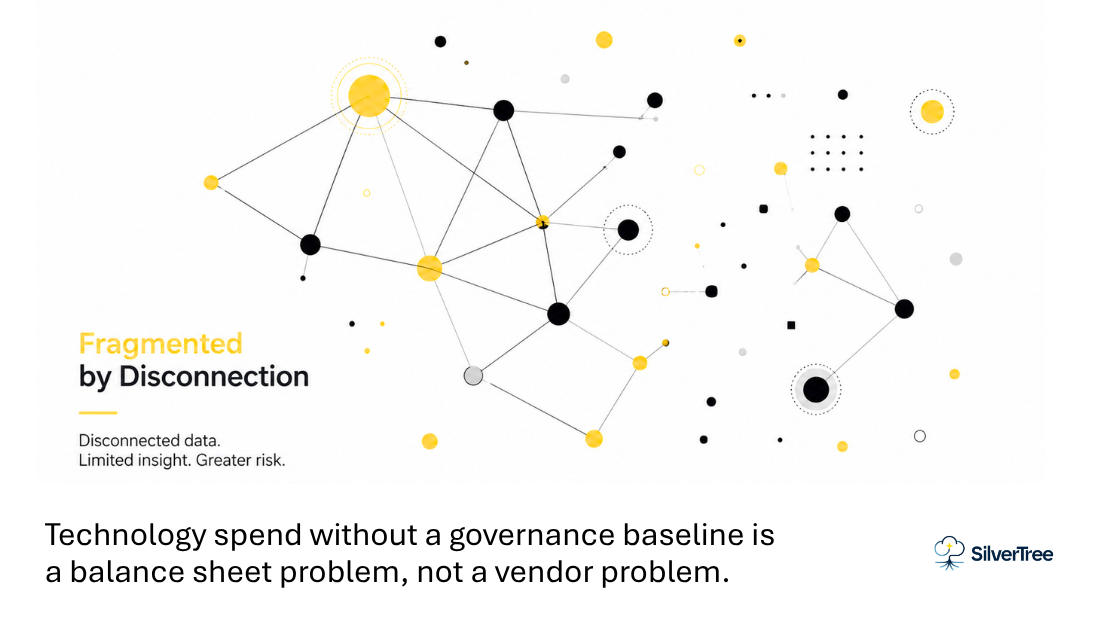
This is a governance problem, not a vendor problem. Mid-market companies typically lack the internal infrastructure to assess technology return: no KPI framework tied to business outcomes, no structured review cadence, no baseline measurement taken before deployment. When the CFO asks what a $400K platform implementation returned, the answer is usually anecdotal.
The work that changes this starts with data readiness and governance, not tools. Before AI can return anything measurable, a trusted data foundation and a KPI framework that defines what working looks like must already be in place. The companies generating measurable AI returns in 2026 built that layer 12 to 18 months ago.
CEOs who govern on evidence run companies 20% more profitably (Silver Tree Corporate Overview, May 2026). That advantage is not a dashboard upgrade. It is a governance model where hard calls get made on evidence, and it compounds into enterprise value over time.
54% of US CEOs Rank Cyberattack as Their Top Geopolitical Threat. Mid-Market Security Posture Has Not Kept Pace
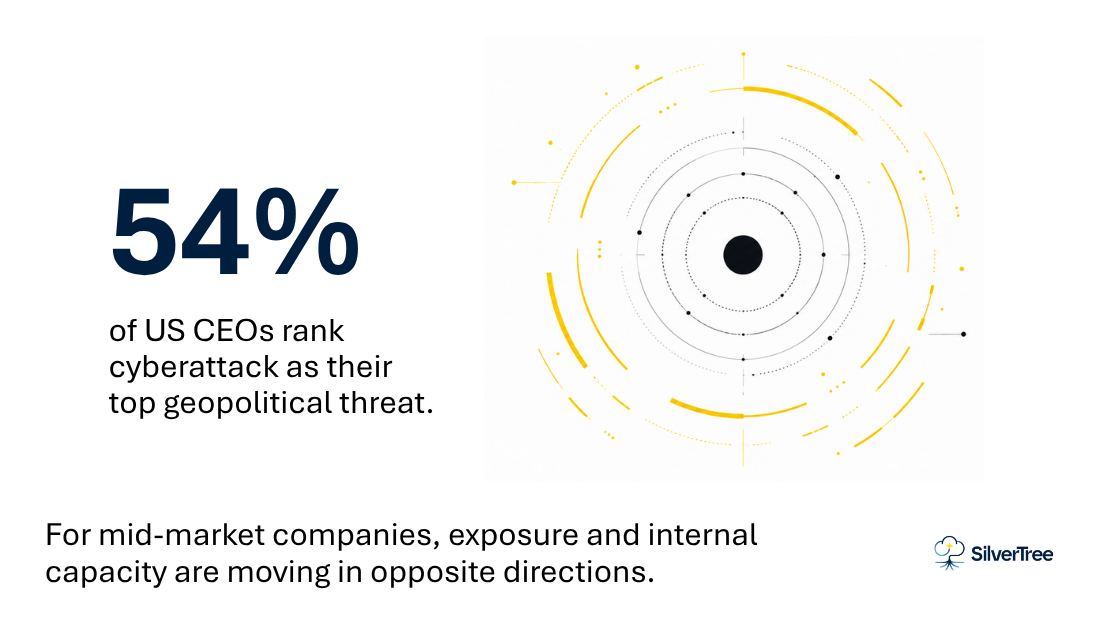
The Conference Board's C-Suite Outlook 2026 found 54% of US CEOs rank cyberattack as their top geopolitical threat. That statistic belongs on a board agenda, not an IT ticket. Mid-market companies sit in a specific risk position: complex enough to be targets, under-resourced enough to be exposed.
The At-Bay 2025 InsurSec Report found mid-market companies experienced a 67% increase in ransomware claims over the prior year. A 400-person company typically does not have a dedicated security operations function. They have an IT team that handles security when something flags, a compliance checklist updated annually, and a cyber insurance policy that may not cover the actual exposure. That is not a security posture. It is a liability.
A realistic security posture at that scale is not a $2M SOC build. It is a structured assessment that identifies where actual exposure sits, a governance model that makes security a board-level KPI, and a managed service providing 24/7 monitoring without requiring a 10-person internal team. The goal is not to spend more. It is to stop spending blind.
Critical Roles Are Taking Six Months to Fill, and Every Month of Delay Is a Month of Strategic Stall
The Conference Board found 43% of US CEOs cite talent as a top challenge for 2026. Capstone Partners found 22.2% of mid-market CEOs rank increasing profitability as their leading operational initiative for the year. Both are connected. When a critical role in data, security, AI, or program management stays empty for six months, every initiative that role was meant to drive stalls. Work redistributes to people already at capacity. Business cases get quietly shelved.
The mid-market talent challenge is specific. Enterprise firms pay for it. Boutique firms can sometimes move faster on niche searches. Mid-market companies are stuck in the middle: too large to hire slowly, too resource-constrained to compete on package alone for specialized roles.
Silver Tree's Workforce Solutions practice leads with practice depth. The starting question is not how many candidates can be sourced. It is what this role needs to deliver in 90 days and what the right person looks like to do that. That framing produces a different engagement and a different outcome than a volume search.
The operating discipline gap: Mid-market companies face enterprise-scale complexity with mid-market resources. The discipline that large enterprises apply to operations, security, data, and talent is not out of reach. It is delivered at the right scale by the right partner.
Frequently Asked Questions
How do mid-market companies reduce costs without cutting into growth capacity?
Identify operating drag before making any cuts. Recurring IT failures, manual processes, and unresolved data quality issues consume budget without producing output. Quantifying those costs first tells you where the real savings are. CBIZ found 84% of mid-market leaders are prioritizing cost optimization this year (CBIZ, Feb 2026). The ones protecting margin are not just cutting. They are eliminating drag that was never visible on a P&L.
What does a realistic AI investment look like for a 300-person company in 2026?
It starts with data governance, not tools. Before AI can return anything measurable, clean and reliable data and a KPI framework that defines what working looks like must already be in place. The Conference Board found 46% of US CEOs say measuring AI ROI is their top AI priority (Conference Board, Jan 2026). A 300-person company deploying AI without that foundation is spending money on outputs it cannot evaluate.
How should a mid-market CEO think about cybersecurity without a dedicated internal team?
Treat it as a business continuity question, not an IT question. The Conference Board found 54% of US CEOs rank cyberattack as their top geopolitical threat. Start with a structured assessment to identify actual exposure gaps. A managed security model providing 24/7 monitoring is viable at 200 employees and up, at a fraction of the cost of an internal team.
What is the Silver Catalyst assessment and what does it produce?
It is a structured business performance assessment that starts with understanding the operational problem, not proposing a solution. The output is a prioritized gap analysis tied to business outcomes: where margin is being lost, where operating drag is costing revenue, and where the highest-return investments are. It begins with a 30-minute conversation to determine whether and how Silver Tree can help. It is not a sales call.
Sources
CBIZ. Q1 2026 Mid-Market Pulse Report. February 19, 2026. Based on 1,300+ mid-market businesses and advisors.
The Conference Board. C-Suite Outlook 2026. January 15, 2026. Survey of 1,732 executives including 771 CEOs.
JPMorgan Chase. 2026 Business Leaders Outlook. January 7, 2026.
Capstone Partners. Middle Market Business Owners Survey. December 2025.
At-Bay. 2025 InsurSec Report.


Richard Ricks is the founder of Silver Tree Consulting & Services and a veteran technology executive with decades of leadership experience in IT, outsourcing, and business transformation. A former CIO of Nortel Networks and senior executive at CSC, he has led large-scale technology and operational transformations for global organizations, delivering measurable business value through innovation, leadership, and disciplined execution.
