
IT360Secure and Vigilance - The Performance Visibility Gap in Manufacturing
Factories are spending millions on digital tools, but 57% of operational data is wasted while plants burn 27 hours a month on surprise outages. Discover how establishing an IT performance baseline bridges the gap between collecting tech data and driving operational uptime.
Key Takeaways
- 90% of manufacturers now say digital transformation is essential to staying competitive, while 59% are already using smart manufacturing technologies in operations. (Rockwell Automation, May 2026)
- 80% of surveyed manufacturing executives planned to invest 20% or more of their improvement budgets in smart manufacturing initiatives, increasing the need to manage technology as an operating system rather than a collection of projects. (Deloitte, November 2025)
- Large manufacturers still experienced an average of 27 hours of unplanned downtime per plant each month in Siemens' 2024 research, despite significant progress in reducing downtime incidents. (Siemens, 2024)
- The operational challenge is no longer simply adding more technology. It is establishing enough visibility to understand how the technology environment is performing and where intervention matters most. (Silver Tree, 2026)
TL;DR
Factories are spending millions on new digital gear, linked hardware, automation, and AI. These investments increase the importance of knowing whether the underlying IT environment is performing as expected, because collecting mountains of data gets you nowhere if nobody uses it.
Rockwell notes that factories ignore or waste 57% of their data, while Siemens reports large plants still burn 27 hours a month on surprise outages.
Real operational edge comes from turning all that raw noise into one clear picture of tech performance. That way leaders spot chronic bugs, rank real risks, and stop throwing money at the wrong fixes.
Factory tech is changing far quicker than the playbooks used to run it. According to Rockwell Automation's 2026 State of Smart Manufacturing study, 90% of manufacturers agree that digital tools are mandatory to stay competitive, and 59% have put them to work. The problem is what happens next: organizations currently put just 43% of their operational data to actual use.
Which creates a less visible problem beneath the investment story.
Modern plants generate mountains of data across cloud apps, shop floor hardware, and corporate networks. Yet few leaders can point to a realistic benchmark for overall IT health. That is a real problem. In manufacturing, unstable IT immediately hits output, cuts into labor efficiency, and clouds strategic decisions.
Manufacturing technology investment is increasing the need for operational visibility
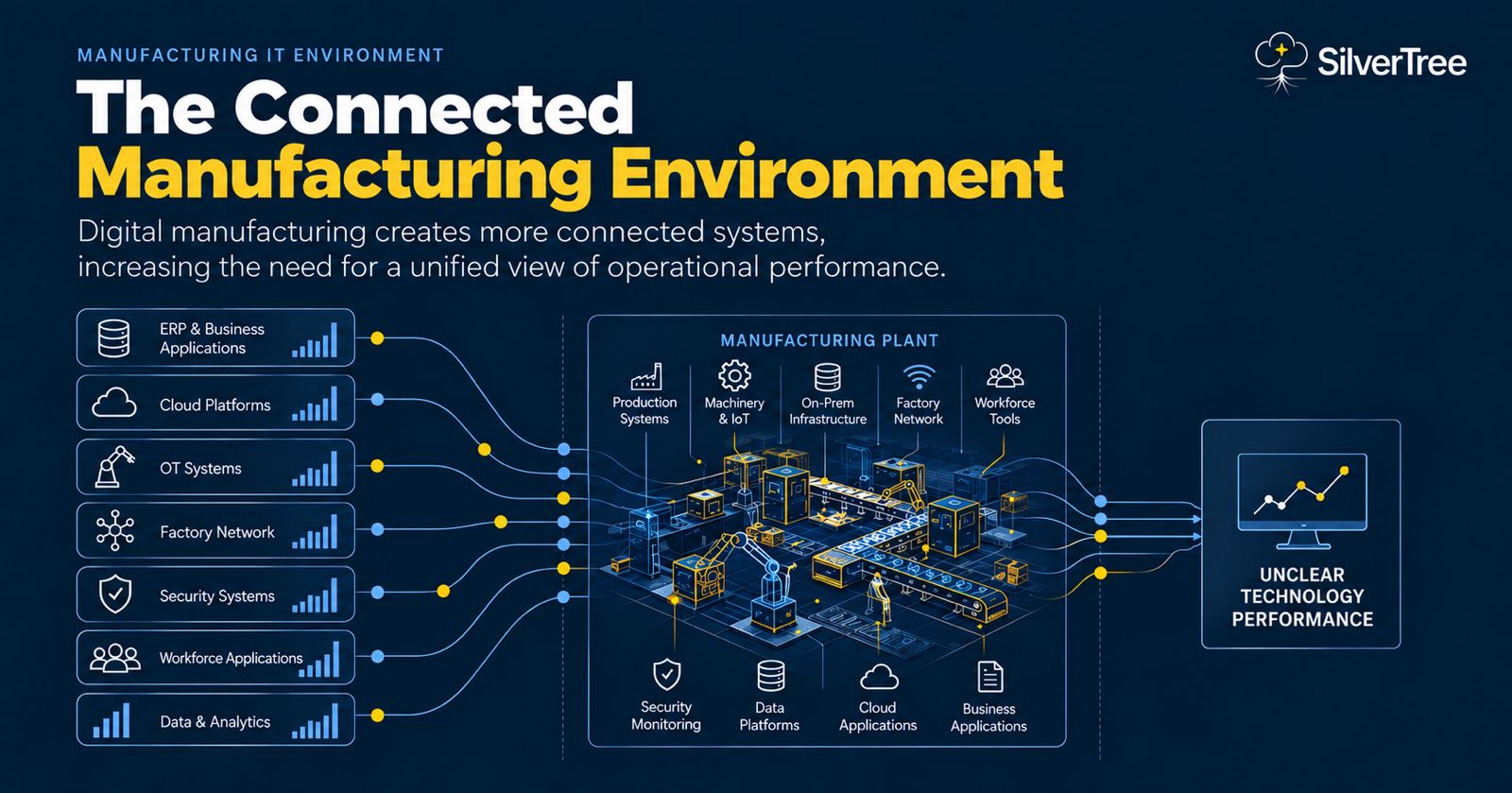
The manufacturing technology environment is no longer a collection of isolated systems supporting the plant. Modern factories now run on digital networks that bridge everything from the shop floor and logistics to core business apps and security.
The scale of this push comes through clearly in Deloitte's 2026 Manufacturing Industry Outlook. In their survey of 600 executives, 80% revealed plans to sink at least a fifth of their improvement budgets straight into smart manufacturing. Continuous spending on smart operations remains a primary priority across the sector.
When systems are added one at a time, each can appear healthy in isolation. The ERP system may be available. The network may be within its expected thresholds. Cloud applications may report normal availability. Security monitoring may be generating alerts.
But those individual signals do not necessarily tell leadership whether the technology environment as a whole is supporting the business effectively.
Checking whether a server or app is technically online is not enough for an IT leader in manufacturing. They have to see the bigger picture. That means tracking repeat outages, watching speed trends, mapping dependencies, and spotting exactly where clunky software slows down factory workers.
Downtime shows what happens when technology performance becomes a business problem
Reliability on the factory floor is moving in the right direction. Monthly downtime events dropped from 42 in 2019 down to 25 in recent years, pulling total lost time down from 39 hours to 27. The problem is that losing 27 hours a month still equates to wiping out over twenty-four straight hours of manufacturing work.
(Siemens, 2024)The economics can be much more severe in certain sectors. Equipment breakdowns at a major auto plant can bleed $2.3 million per hour. To fight back, factories are gathering massive amounts of machine data, with 87% of major plants collecting information meant for predictive maintenance. The trouble is that nearly three-quarters still rely on old factory historians. Those legacy setups simply cannot keep up with the complex data feeds modern predictive systems require.
(Siemens, 2024) The lesson extends beyond equipment maintenance.
For IT leaders, the equivalent problem is having monitoring data without a consistent view of performance across the environment.
More monitoring does not automatically create a performance baseline
Mid-market companies frequently struggle with fragmented software, juggling too many vendors, disconnected dashboards, and playing defense on IT tickets. Solving this is not about adding metrics. It comes down to swapping basic SLA targets for real operational impact, such as systemic reliability, streamlined cross-team response, reduced exposure, and higher workforce output.
An IT team might know how many tickets were opened last month. It might know how many alerts were generated or whether individual systems met their availability targets. Those metrics can be useful, but they do not necessarily establish whether technology performance is improving.
A useful baseline should allow leadership to see patterns over time:
- Are recurring incidents declining?
- Are critical systems becoming more stable?
- Are problems concentrated around a particular application, infrastructure layer, vendor, or location?
- Is the technology environment creating friction for employees or operations?
Without that context, IT management can become reactive. Teams spend time responding to individual symptoms while leadership lacks the evidence needed to decide where investment or intervention will have the greatest business impact.
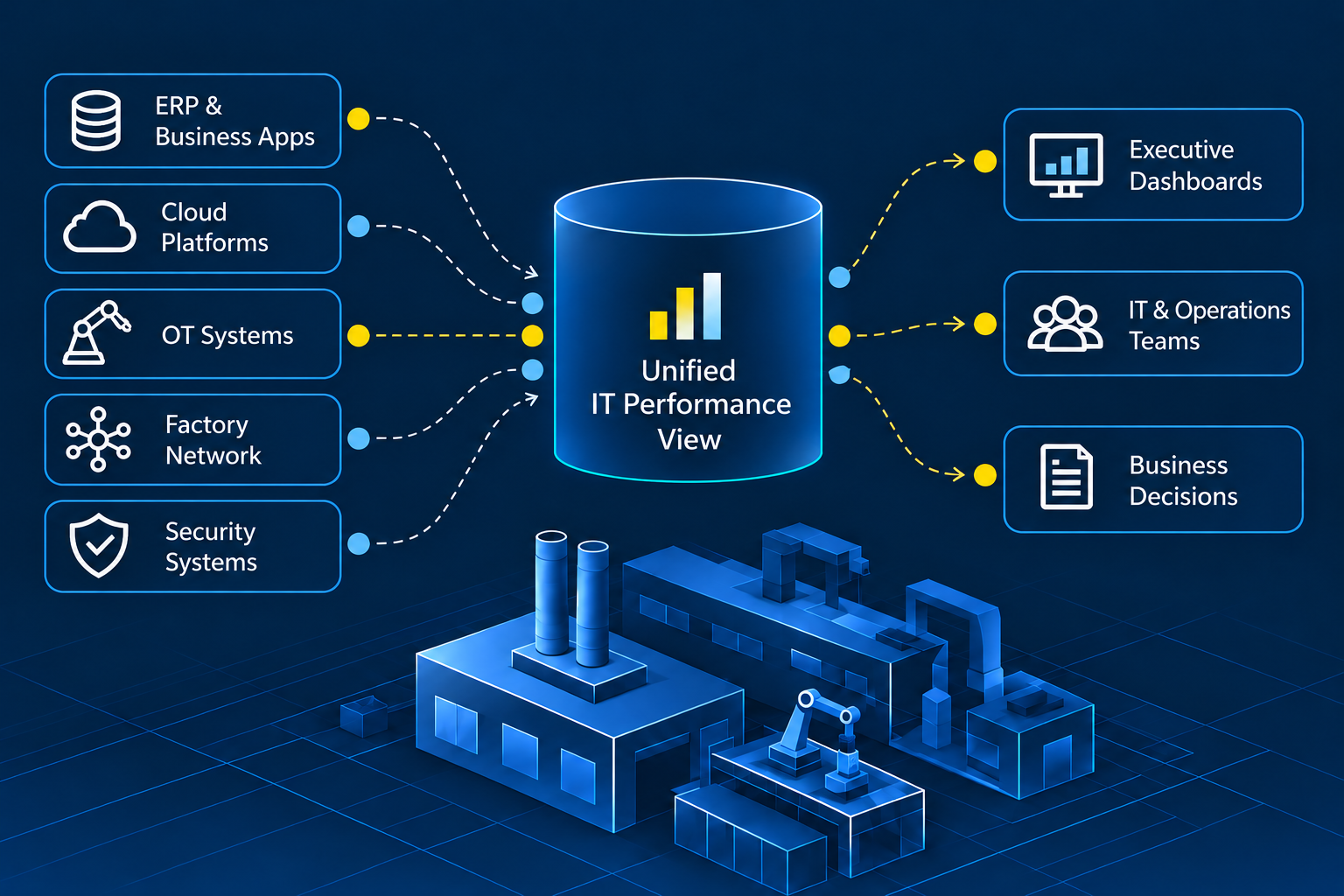
The gap between collecting IT signals and turning them into an executive view of performance is where operational visibility becomes valuable.
Vigilance creates a foundation for managing IT performance as an operating discipline
This is where Silver Tree's approach moves beyond simply adding another monitoring layer.
Vigilance is positioned within Silver Tree's portfolio as an ESMaaS platform, or IT Business Management as a Service, designed around the operational management of technology rather than isolated tools.
The distinction is important for manufacturing organizations dealing with increasingly connected environments.
The goal is not to give IT another place to look for alerts. The goal is to make technology performance easier to understand, manage, and discuss in business terms.
That aligns with Silver Tree's broader operating model, which emphasizes integrated IT and security ownership, accountability for operational outcomes, and clear operational performance visibility. The positioning framework specifically identifies improved visibility into system performance as an intended outcome of a disciplined operating model.
For a manufacturer, that can change the conversation from:
“What broke?”
to:
“What is changing in our technology performance, what is causing it, and where should we act?”
That shift becomes increasingly important as manufacturers move from digital pilots to scaled operations.
Rockwell's 2026 research shows that the industry is already moving in that direction, with 59% of manufacturers actively using smart manufacturing technologies and 34% of operations already AI-augmented (Rockwell Automation, May 2026).
The more technology becomes part of production and business operations, the less room there is for IT leaders to manage it through disconnected signals.
The next manufacturing advantage is knowing what technology performance looks like
Manufacturers have spent years improving visibility into machines, production processes, supply chains, and maintenance.
IT operations need the same discipline.
The data already exists. Rockwell's research shows manufacturers are generating significant amounts of operational data, but only 43% is currently being used effectively (Rockwell Automation, May 2026).
The issue is therefore not simply data availability. It is whether the organization can turn that data into a consistent understanding of performance.
For mid-market manufacturers, this matters even more because technology environments can become enterprise-level in complexity while internal IT teams remain comparatively lean.
Silver Tree's positioning framework describes this mismatch as a source of hidden operational risk and emphasizes enterprise operating discipline without enterprise overhead.
A performance baseline gives leaders a real benchmark to see if systems are actually stabilizing, where repeat breakdowns are hiding, and which projects deserve real funding. Closing that visibility gap has to happen first, long before throwing another piece of software at the plant floor.
FAQs
Why is IT performance visibility important in manufacturing?
Manufacturing depends on technology across production, business applications, infrastructure, workforce systems, and security. When performance problems cross those boundaries, individual monitoring tools may not show the full business impact. A consistent performance view helps IT leaders identify patterns and prioritize intervention.
What should a manufacturing IT performance baseline include?
It should establish measurable reference points for system reliability, recurring incidents, performance trends, and operational impact. The exact metrics depend on the environment, but the objective is to move beyond isolated alerts toward a view of whether technology operations are becoming more stable.
How does downtime data relate to IT performance visibility?
Downtime demonstrates the financial consequence of operational disruption. Siemens' 2024 research found that large plants still lost an average of 27 hours per month to unplanned downtime. IT performance visibility helps organizations identify technology-related patterns before they become larger operational problems.
Mid-market manufacturers without a clear baseline need to step back and take inventory. That means running a full audit on active systems, monitoring tools, repeat outages, dependencies, and performance metrics. Bringing in a structured maturity assessment and operational benchmarking gives executives the visibility they need to map out tech risks and target their upgrade dollars.
When technology performance is difficult to measure, the first decision is not which tool to buy. It is what the business needs to be able to see.

Darwin Herdman brings over 30 years of leadership experience in building, scaling, and optimizing managed service operations for a diverse range of organizations—including small and mid-sized businesses (SMBs), Fortune 100 enterprises, state and local governments, and tier-one telecommunications providers.
Throughout his career, Darwin has led high-impact initiatives that modernized IT service delivery, streamlined operations, and introduced automation frameworks at scale. His work spans every layer of the managed services stack, from service desk and infrastructure management to cloud operations, security services, and digital employee experience platforms.
Darwin's deep expertise in operational design, service orchestration, and technology transformation makes him uniquely qualified to articulate the vision and operational blueprint for Autonomous IT. His insights are grounded in decades of real-world execution, delivering measurable outcomes for some of the most complex and high-demand IT environments in North America.
